Dr. Lisa Folden didn’t set out to revolutionize her physical therapy practice. She was traditionally trained, focused on performance and aesthetics like most in her field. But after her third pregnancy, something shifted. The applause she received for her “discipline”—working out seven days a week, eating fewer than 1,200 calories a day, weighing herself every morning—masked a darker reality. She was struggling with disordered eating and exercise habits that looked like wellness from the outside but felt like prison from the inside.
That personal crisis became the catalyst for a complete transformation in how she approaches patient care. In this episode of Project Longevity, Dr. Lisa Folden shares her journey from traditional physical therapist to behavior change specialist with a weight-inclusive, trauma-informed practice. She and Caulen discuss why the pursuit of body goals undermines acceptance, why intentional weight loss has a 98% failure rate, and what health metrics actually matter when aesthetics are removed from the equation.1
This is a conversation about letting go of control, normalizing bodies, and redefining what it means to be healthy. It’s also a reminder that the behaviors we celebrate in diet culture can sometimes be the ones that need the most care.
Prefer listening instead? Tune in to Project Longevity: Season 1, Episode 3 with Dr. Lisa Folden on Spotify, Apple Podcasts, Amazon Music, and other major podcast platforms.



From Traditional Physical Therapy to Trauma-Informed Care
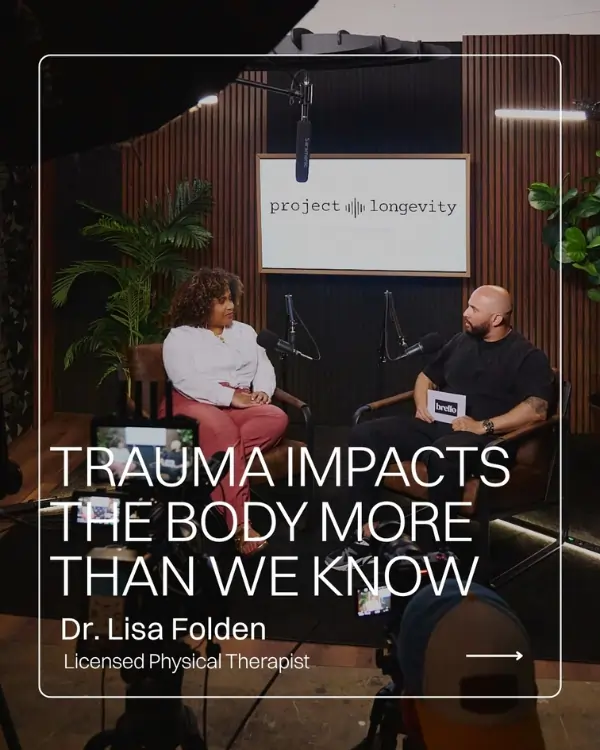
Dr. Lisa Folden’s training as a physical therapist followed a predictable path. You come in with knee pain, she treats your knee. The focus was clinical, targeted, and largely divorced from the emotional landscape of the patient. But over 18 years of practice, she began to notice something her education hadn’t prepared her for: the trauma and emotional experiences people carry have a profound impact on their physical healing.
When Caulen asks how trauma has evolved in her work, Lisa explains that it’s essentially taken over her practice. What used to be quick, exercise-based sessions now look more like mental health therapy. She spends time talking, asking questions, getting to know not just the injury but the person living with it. Because while many people can push through pain, what truly matters is when that pain stops them from doing something they love.
Her trauma-informed lens doesn’t replace therapy—most of her clients are also working with mental health professionals. Instead, it’s about intuition and empathy. If someone walks in exhausted, going through a divorce, or struggling emotionally, she doesn’t push them through an intense workout. She dials it back, leans into stretching, and creates a somatic experience that calms the nervous system rather than activating it further. Every session is different because every patient’s needs are different, moment to moment.
Lisa attributes this approach to her own struggles. In her words, “One thousand percent” her empathy comes from lived experience. She learned that you don’t know someone’s story unless you ask. You can’t make assumptions based on demographics alone. That realization reshaped not just her clinical work, but the language she uses—she never talks about being “triggered,” for example. She speaks about being “activated.” Small shifts in language change everything.
When “Discipline” Masked Disordered Eating
Lisa grew up the oldest of seven children in Detroit, Michigan. She was always in charge of people. After earning her doctorate in physical therapy, she relocated to Charlotte, North Carolina, where she built a practice and a life. But after her third child was born, something unraveled.

On the surface, she looked like the picture of health. She worked out seven days a week. She ate all her food from pre-portioned containers—probably fewer than 1,200 calories a day. She was raising three kids under the age of five, running a business, and holding a marriage together that would eventually fail. People applauded her discipline. They asked how she did it. But underneath, Lisa was living in a dark place.
Her mental health was unraveling. She went to bed hungry every night. She weighed herself every morning. Her thoughts revolved entirely around what she would eat and how she would move. Because her body never became clinically underweight—according to the deeply flawed BMI system—no one screened her for disordered eating.2 Instead, she received praise.
One of her strongest lines comes when she reflects on this period: “The behaviors that people saw on the outside mimic exactly what is encouraged in diet culture. So all I got was applause for it when really I needed care.”
When she finally eased off the extreme restriction and exercise, her body changed immediately. The depression that followed—watching her body shift despite still working out—sent her into a spiral. She felt like she was losing control. And that’s when she stumbled upon a book that changed everything.
The Science Behind Health at Every Size
The book was Health at Every Size by Dr. Lindo Bacon. For Lisa, it provided the science her brain needed to understand why her body kept “fighting” her and why the weight she thought it should be wasn’t actually the weight that was healthy for her.3
The Health at Every Size (HAES) framework challenges the widely held belief that health can be determined by body size alone. It shifts focus away from weight loss as a primary health goal and instead emphasizes behaviors that support wellbeing—things like intuitive eating, joyful movement, and reducing weight stigma.3 Research shows that weight-neutral approaches to health lead to more sustainable, positive outcomes than traditional weight-focused interventions.4
For Lisa, this reframing was revelatory. She had been taught that if you eat the right foods and move in the right ways, your body will be small, fit, and healthy. But the reality is that everyone has different levels of access to health, and everyone’s bodies are supposed to be different. Some people will be fat no matter what they do—because of genetics, environment, medications, or a host of other factors—and that doesn’t mean they’re unhealthy.
Lisa acknowledges this is shocking for many people to hear, especially in a culture that equates thinness with virtue. But she speaks from lived experience. She’s a planner, type-A, the daughter of a fitness competitor who won Mr. Michigan in 1989. She watched her father transform his body and believed she could do the same. Realizing that long-term body manipulation isn’t how biology works was difficult. But it was also liberating.
That science became the foundation of her weight-inclusive, trauma-informed practice, which she formally launched in 2021.
You Cannot Accept Your Body While Trying to Change It
Caulen poses a question many people grapple with: What about someone who has a goal weight? Not for vanity, but because they believe it’s a healthier range for them personally. How do you pursue that goal while also working toward body acceptance?
Lisa’s answer is direct and uncompromising. “You cannot simultaneously achieve body acceptance if you have a body goal. They are one hundred percent in opposition to each other.”
If you have a desire to look a certain way, you can’t accept your body as it is. Acceptance means releasing the condition that your body must change in order to be worthy. It means shifting focus away from aesthetics entirely and toward metrics that actually reflect health: strength, flexibility, endurance, blood pressure, blood glucose, sleep quality, hydration, mental clarity.5
These are the areas Lisa encourages her clients to monitor and set goals around. Not what the body weighs, but what it can do and how it feels. It’s a fundamental reframe that asks people to separate their self-worth from their size—a radical act in a culture built on diet messaging and body commodification.
Why 98% of Intentional Weight Loss Efforts Fail
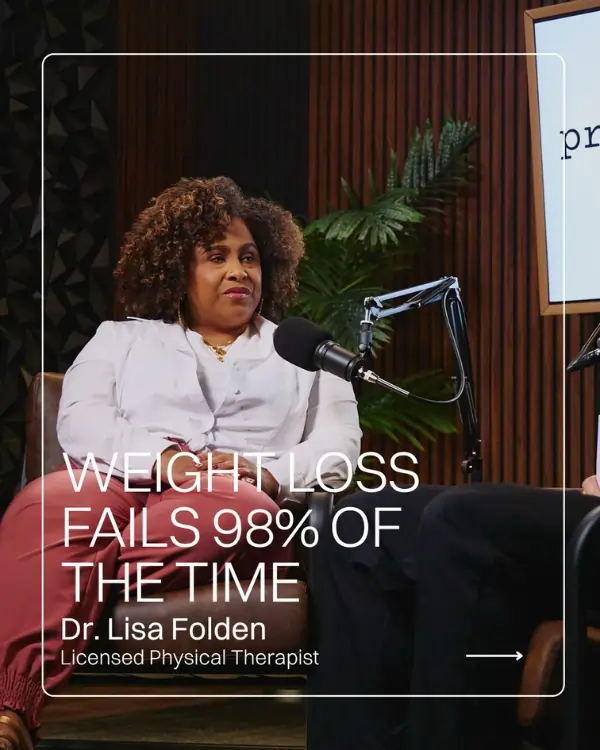
Lisa makes a bold claim that stops many listeners in their tracks: intentional weight loss fails at a rate of 98%.1 She’s categorically anti-diet because the evidence shows that diets don’t work long-term for the vast majority of people. Weight cycling—the pattern of losing and regaining weight repeatedly—is associated with negative health outcomes, including increased inflammation and cardiovascular risk.6
But Lisa is quick to distinguish between being anti-diet and being anti-dieter. She fully supports people making their own choices about their bodies and their health. However, she’s also clear that if someone is focused on a weight goal, she’s probably not the right coach for them because she will never center that number.
What she believes—and what research increasingly supports—is that a weight-neutral approach to fitness is more effective and sustainable.4 When people focus on health behaviors rather than weight outcomes, they’re more likely to maintain those behaviors over time. They’re also less likely to engage in the harmful cycles of restriction and bingeing that characterize yo-yo dieting.
Lisa explains that humans are competitive by nature. When we fixate on a number, we shift into unhealthy behaviors to achieve it. We might have been sleeping well, drinking water, eating a variety of foods, and moving our bodies consistently. But the moment we become obsessed with hitting a specific weight, those healthy habits get replaced by restriction, over-exercising, and obsessive monitoring. The pursuit of the number undermines the health we were actually building.
Health Metrics That Actually Matter
So if the scale isn’t the answer, what is? Lisa offers a comprehensive list of metrics that actually reflect someone’s health and quality of life.
Physical metrics include strength, range of motion, flexibility, speed, and endurance. These are measurable, functional indicators of what your body can do. Medical metrics like blood pressure, blood glucose, and cholesterol levels provide insight into cardiovascular and metabolic health.7 Then there are lifestyle metrics: How well are you sleeping? How much water are you drinking? Do you feel mentally clear? These factors have a profound impact on overall wellbeing.
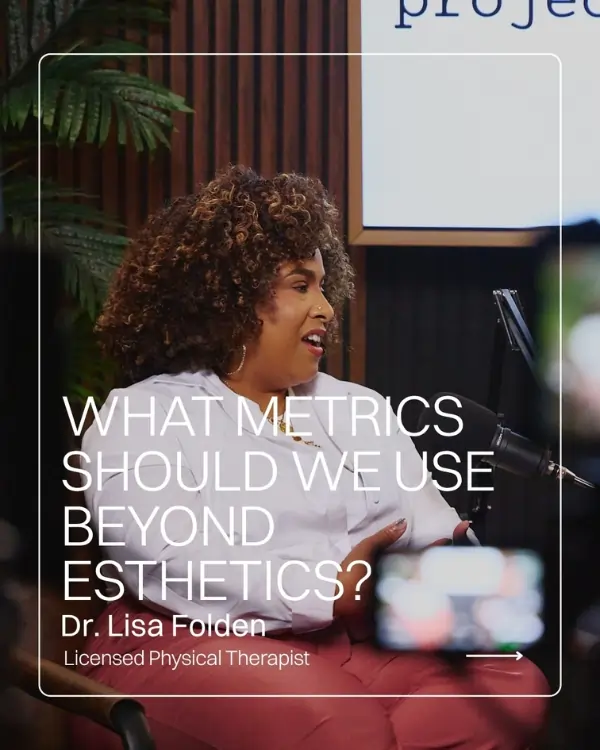
Caulen asks whether weight loss can still be a byproduct of focusing on these other metrics. Lisa’s answer is nuanced. For some people, yes—when they prioritize health behaviors without fixating on weight, their body composition may naturally shift. But for others, it won’t. And that doesn’t mean they’re failing. It means their body has found its set point, the weight range it’s biologically programmed to maintain.8
The key is removing aesthetics from the equation entirely. When you focus on how your body feels and what it can do—rather than how it looks—the conversation changes. Progress becomes about climbing stairs without getting winded, playing with your grandkids, or completing a 5K. It’s about function, not form.
The Scale Is a Tool—But Not for Everyone
Caulen presses further. What about people who simply like tracking numbers? Is there a middle ground where someone can check their weight occasionally without it becoming harmful?
Lisa’s response is grounded in individual assessment. The scale is a metric. For some people—those without a fraught history with weight or disordered eating—checking their weight might be neutral. It doesn’t activate them. It doesn’t change their day. For those people, occasional weigh-ins can be just another data point.
But for others—especially those recovering from eating disorders or with a history of body image struggles—the scale is dangerous. Lisa herself doesn’t even own a scale. For her and the population she works with, stepping on a scale would be activating every single day. It would spiral into obsessive thoughts about food, movement, and body checking.
The distinction Lisa emphasizes is honesty with yourself. If checking your weight leads to obsessive thoughts about calories, if you start comparing yourself to others, if you find yourself constantly looking in the mirror or measuring parts of your body, then the scale is not the right tool for you. And that’s okay. There are dozens of other ways to measure progress that don’t involve a number.
Body Checking and the Comparison Trap
Body checking—constantly examining your body, comparing yourself to others, scrutinizing every angle in the mirror—is one of the most insidious habits that can take root when weight becomes the focus. Lisa sees it often in her clients, and she experienced it herself.
When your mind is consumed with thoughts about your body, weight, and food, it’s a signal that something is out of balance. The mental load of constant body surveillance is exhausting and keeps people locked in cycles of shame and negative self-talk.
Caulen asks if there are tools to help reduce this behavior. Lisa’s answer is both simple and profound: normalize your own body and normalize other bodies.
Normalizing Bodies Reduces Shame
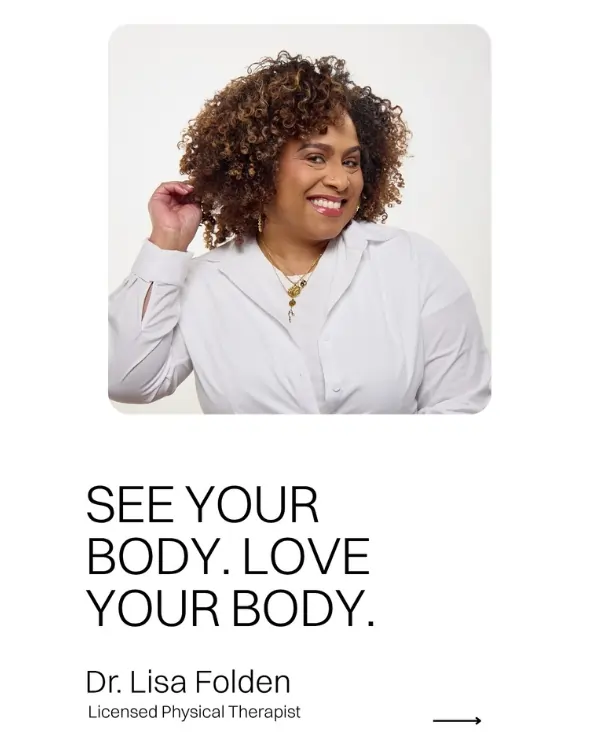
The first step is to look at your own body fully and become familiar with it. When we don’t like something, we avoid it. But the more you see your body, the less shocking or upsetting it becomes. It’s exposure therapy in its most basic form.
The second step is to normalize other bodies. We tend to be more critical of ourselves than we are of others. So Lisa encourages people to follow a diverse range of bodies on social media—people who look like them and people who don’t. Watching others live their lives confidently in bodies of all sizes helps shift perspective. It reduces the tendency to compare and opens up space for self-compassion.
This practice isn’t about toxic positivity or pretending to love every part of yourself immediately — it’s closer to body neutrality, an approach grounded in building familiarity, reducing fear, and recognizing that bodies are meant to be different. When you stop seeing your body as the enemy, you create room for a more peaceful relationship with it.
Function Over Form: What Real Progress Looks Like
Lisa’s definition of success in her practice revolves entirely around function. Can you go up and down stairs without pain? Can you chase your kids or grandkids? Can you get up from the floor independently?
That last one is particularly significant. Research shows that the ability to sit down on the floor and stand back up without using your hands is a strong predictor of longevity and functional independence as we age.9 It requires strength, balance, flexibility, and coordination—all markers of healthy aging.
For some clients, success looks like performance goals: completing a 5K, lifting a certain amount of weight, or improving cardiovascular endurance. For others, it’s simply being able to do daily activities without limitation. Lisa doesn’t impose targets. Instead, she asks clients what matters to them and helps them articulate their “why.” Without a meaningful reason behind a goal, people don’t stick with it.
When aesthetics are removed and function takes center stage, the metrics of progress become deeply personal and far more motivating. It’s not about fitting into a certain size. It’s about living fully in the body you have.
The “Why” That Keeps You Going
Caulen asks Lisa about her own “why”—what motivates her to move, to take care of herself, to keep showing up for her health. Her answer is twofold.
First, she wants to maintain a good quality of life as she ages. She wants to remain independent, active, and engaged in the world. But more importantly, she wants to be an example for her three children.
Lisa wants them to see that she moves her body, but she also rests. She eats well, but she also enjoys treats. She spends time with them, but she also takes time for herself. She wants them to witness a full, balanced life—one that doesn’t revolve around obsessive control or perfection.
Health, she explains, isn’t just physical. It’s emotional, mental, social, and even financial. It’s about showing up for yourself and for the people you love in a sustainable, compassionate way. That’s the legacy she’s building for her children, and it’s the model she brings to her clients every day.
Quality Over Quantity: Redefining Longevity
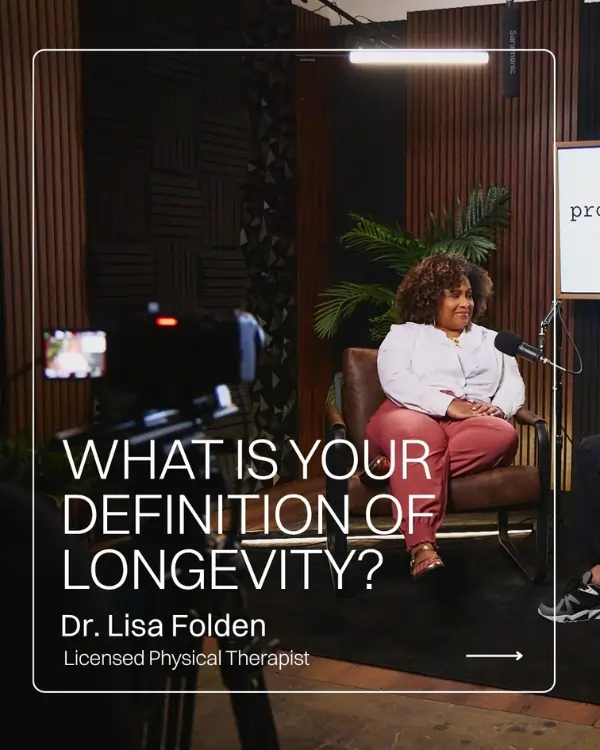
When Caulen asks Lisa to define longevity, her answer challenges the conventional obsession with lifespan. For her, longevity isn’t about living as long as possible. It’s about maximizing the quality of your life and using your time and energy in meaningful ways.
This reframe aligns with the broader concept of healthspan—the period of life spent in good health, free from chronic disease and disability.10 Living to 100 means little if those years are marked by pain, immobility, and isolation. True longevity is about maintaining autonomy, connection, and joy throughout your life.
Lisa’s perspective is refreshing in a wellness culture that often prioritizes optimization and anti-aging at all costs. She’s not chasing immortality. She’s chasing presence, purpose, and fulfillment.
The Bigger Picture
Dr. Lisa Folden’s story is one of transformation—from struggling silently under the weight of diet culture’s expectations to building a practice rooted in compassion, evidence, and lived experience. Her journey illustrates a truth that many people are just beginning to understand: the pursuit of health cannot be separated from the pursuit of self-acceptance.
The applause she received for behaviors that were slowly breaking her down is a mirror for how society rewards restriction and control while ignoring the emotional toll. But her willingness to question that narrative—and to rebuild her life and practice around a more expansive definition of health—offers a roadmap for anyone tired of fighting their body.
This episode reminds us that health is not a moral achievement. It’s not something we earn by being disciplined enough or small enough. It’s something we cultivate through compassion, curiosity, and a willingness to let go of the illusion of control. And sometimes, the most radical act of wellness is simply accepting your body as it is today.
If you’re looking for more conversations that challenge conventional wellness narratives, check out Episode 2 of Project Longevity with Blaire Molina, where Caulen dives into functional medicine and personalized health strategies — or revisit Episode 1 with Tori Farrow to start the series from the beginning.