TL;DR Knowing how to dress for body confidence when your body is actively changing starts with fit — wearing clothes that work with your current body, not the size you were or expect to be. For women in a body transition, what feels genuinely like you tends to support clothing confidence more reliably than following style rules or proportion guides.
Getting dressed during a body transition — whether from weight change, hormonal shifts, or the physical changes that come with perimenopause — can feel harder than it used to, and not because you’ve run out of options. Dressing for body confidence when your body is actively changing works differently than most style advice assumes. The rules built for a stable body don’t always translate.
What tends to make more of a difference: fit over fashion rules, and clothing that genuinely connects to how you see yourself right now.
If your body has been changing and getting dressed feels harder than it used to, you’re in the right place.
Is Dressing for Body Confidence Really a Technique Problem — or Something Else?
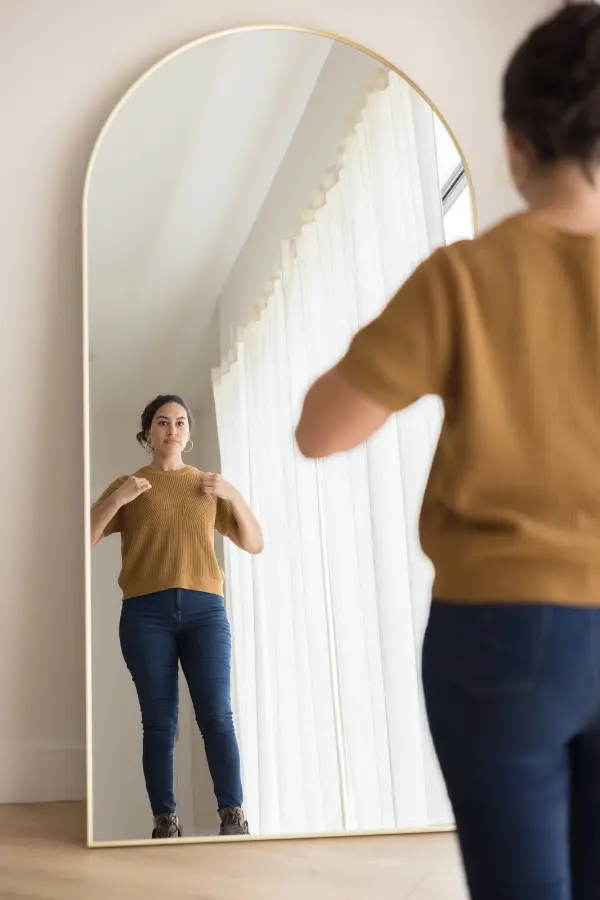
Dressing for body confidence is partly a technique challenge — but for women whose bodies are actively changing, the emotional layer tends to come first. The techniques that help most — fit, proportion, color — work better once the clothes feel like they connect to who you are right now, not who you were.
Why Standard Body Confidence Style Advice Often Doesn’t Translate During a Transition
Standard body confidence advice — body type rules, color theory, proportion tips — was designed for a stable body with a styling problem. For a body in active change, it often addresses the wrong question first. Technique is still useful; it tends to work better as a second step, not the first.
What the Research Suggests About Clothing and Identity
Behavioral research on enclothed cognition shows a real but modest effect: what you wear can influence how you feel, though the effect varies by person and context1. The stronger predictor of sustained clothing confidence appears to be authenticity — whether a garment feels like a genuine expression of your identity rather than a rule you’re following.
Does the Size on the Label Actually Matter for How Clothes Feel?
Size labels are measurement systems, not confidence scores. Clothes that fit the body you have now tend to support a more positive sense of how you look and feel in them — regardless of what number is on the tag. The fit matters more than the label.
The Guilt-Wardrobe Problem — and How to Think About “Waiting” Clothes
The “waiting” closet — clothes set aside for when you’re back to a certain size — creates a low-level tension that makes getting dressed harder every day, and can quietly reinforce negative self-talk patterns that are harder to spot than they are to interrupt. One approach many women find useful: move those pieces somewhere they’re not part of the daily decision. Not necessarily removed — just not a constant reference point while your body is changing. Moving them creates space for body acceptance to take up more room than aspiration does.
Finding Clothes That Fit When Your Size Is Still Moving
Shopping for fit when the body is actively changing means loosening the attachment to permanence. Soft, slightly stretchy fabrics and loosely constructed basics tend to reduce friction — they accommodate body fluctuation without relying on a precise measurement.
How Do You Start Rebuilding Confidence in Clothes When Your Body Has Changed?
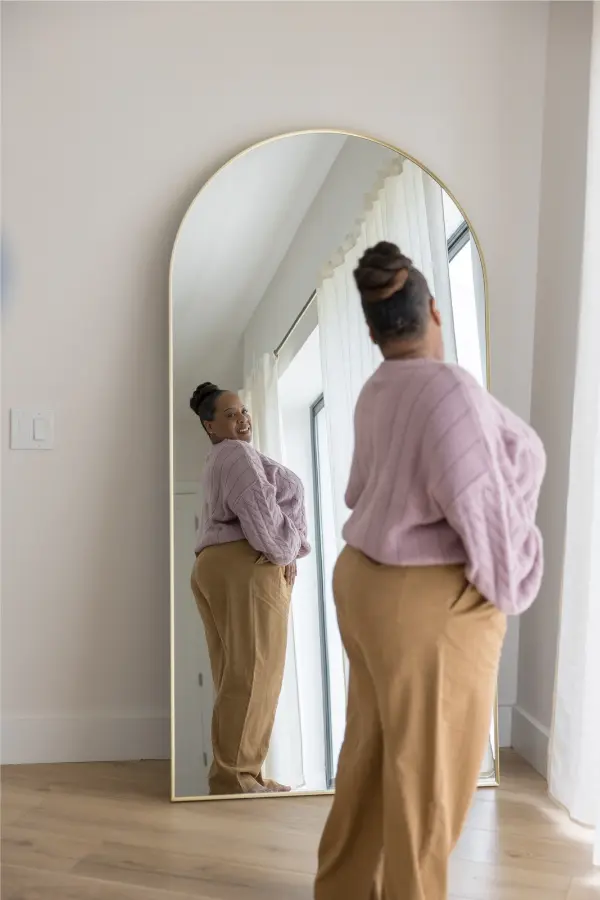
The pattern observed most often in style communities: wearing low-attention, comfortable clothing during the hardest part of a transition, then introducing one small item that feels genuinely like you — a color, texture, or accessory — and gradually expanding from there. This sequence, sometimes called “reclaiming visibility” in style forums, describes the movement from neutral, low-profile dressing to slowly re-entering personal style.
The One-Bold-Item Approach
Adding one item that genuinely reflects your current sense of self — a color you’ve always connected to, a texture that feels grounding, an accessory with personal meaning — can act as a re-entry point into style without requiring a full wardrobe overhaul. The item’s job isn’t to flatter technically. It’s to create a point of connection between the person getting dressed and what she’s wearing.
What It Means to “Dress for Yourself” When You Don’t Fully Recognize Your Body Yet
A more workable version of “dress for yourself” — one that echoes the logic of body neutrality: start with two or three details that have always felt like you — a color, a silhouette, a way of wearing something — regardless of what your body looks like right now. Those anchors tend to stay consistent even when the body doesn’t.
What Style Choices Actually Help When Your Body Is Actively Changing?
The most consistent approach for a body in transition: prioritize fit over fashion rules, build from comfortable basics that work now, and add one or two pieces that feel like an expression of your current self. Some people also find that wearing certain colors feels more grounding or energizing — though color responses are personal and vary2.
Start With Fit, Not Fashion Rules
Fit — the relationship between the garment and the body wearing it — is the most reliable starting point when body-type categories feel inapplicable or the body is still shifting. A well-fitting piece in a simple fabric tends to work better as a foundation than a technically “correct” piece that doesn’t feel comfortable.
A Few Practical Adjustments That Don’t Require Knowing Your “Body Type”
These tend to hold across a range of body changes:
- Fabric first. Soft, slightly stretchy fabrics — jersey, ponte, ponte blends — accommodate body fluctuation better than rigid or heavily structured fabrics.
- Flexible waistbands. Elastic, drawstring, or wrap waistbands remove the need to match an exact measurement.
- One anchor piece per outfit. One item that feels most like you — a favorite color, a jacket you always reach for — can organize the rest of the outfit around it.
- Relaxed fit when uncertain. A piece that’s slightly loose is easier to adjust with a belt, tuck, or layer than one that’s too small.

Take The
First Step
with Brello
Final Thoughts
Getting dressed during a transition isn’t really a problem to solve. It’s part of the process of staying connected to who you are while your body is doing something new.
One place to start this week: look for an item already in your wardrobe that genuinely feels like you right now — not the one you’d describe as perfectly fitting or on-trend, just the one that connects.
Style during a transition isn’t about looking a certain way. It’s about staying present in the body you’re in — and the same principle carries over into how you show up physically.
Frequently Asked Questions
How can I look good and feel confident when my body is changing?
Focusing on fit rather than size or body type tends to be the most reliable starting point. Wearing clothes that work with your body today — even if that means shopping in a new size range — creates a more stable foundation than waiting until the transition feels complete.
How do you look and feel more confident in clothes?
Confidence in clothing tends to build gradually. Start with what fits comfortably, then introduce one item that genuinely feels like an expression of your current self — a color, texture, or style detail that resonates with who you are right now.
Is there a “hardest” body to dress for?
The challenge usually isn’t a body type — it’s a fit problem. Clothes designed for one proportional range often don’t translate to another without adjustment. Prioritizing fit over body-type category tends to resolve most of what gets labeled a “body type” challenge.
Can I feel confident in any outfit even if I don’t feel at home in my body?
Clothing won’t resolve the deeper experience of feeling unfamiliar in your body — but wearing what genuinely feels like you, even in small ways, tends to be more grounding than following rules about what’s technically “flattering.”