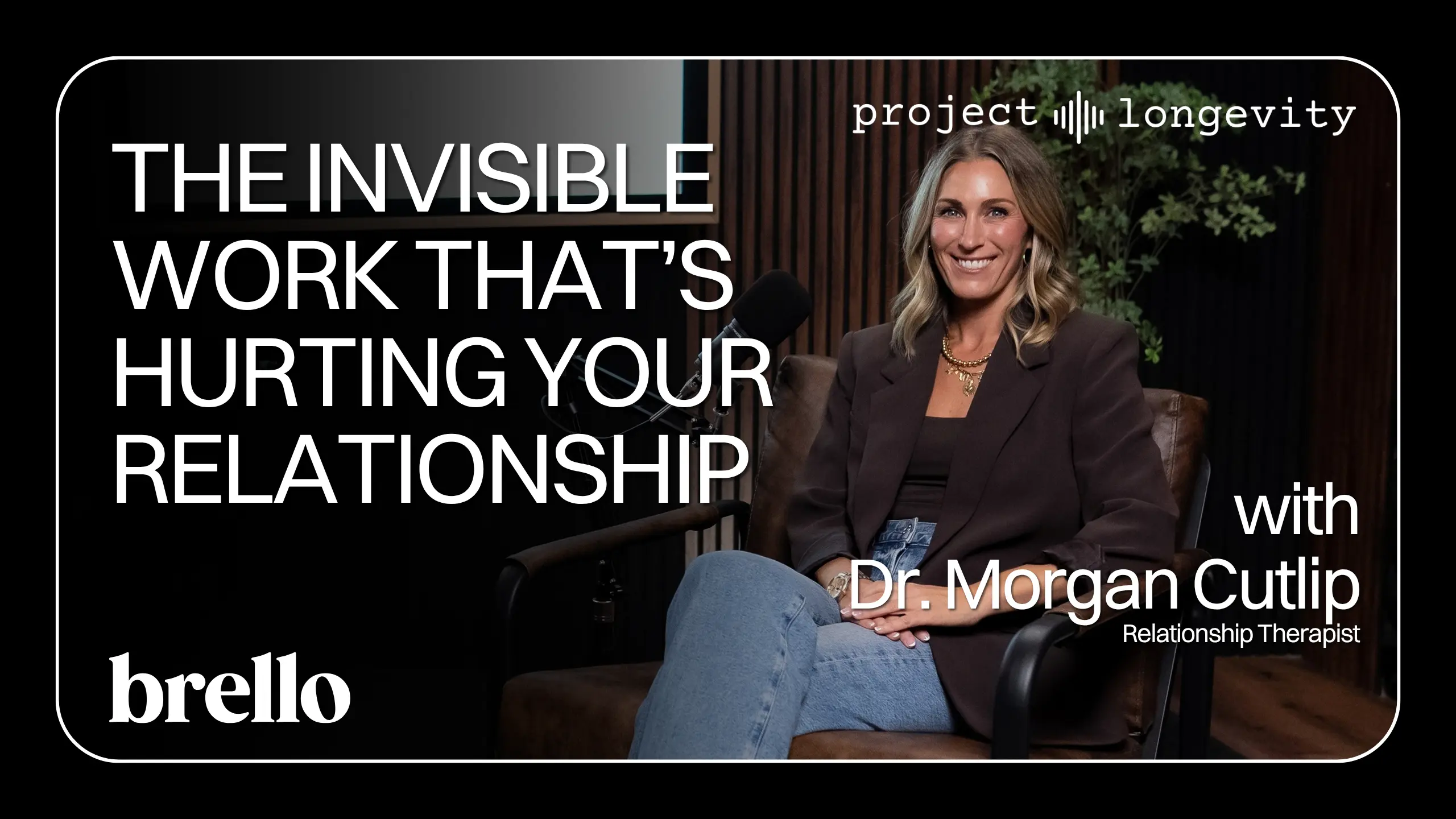
Dr. Morgan Cutlip built her career on a term most couples have felt but never had language for: the mental load. A relationship therapist and researcher with a doctorate in counseling psychology, Morgan has spent 15 years turning research on household labor into tools couples can use. Her book, A Better Share, tackles the invisible labor that quietly costs women their health, intimacy, and well-being. She’s been featured on Good Morning America, in The New York Times, and in Women’s Health.
Her expertise started in her own kitchen, watching her husband walk in with a fresh haircut while she felt like she’d had to rearrange the stars just to use the bathroom. That gap between theory and lived experience became the engine behind everything she’s taught since. Caulen Foster and Morgan unpack why the mental load intensifies after kids and how it quietly erodes intimacy in ways couples don’t expect — friction that isn’t really about the dishes, but about whether both partners feel like active participants in the life they’ve built.
Prefer listening instead? Tune in to Project Longevity: Season 2, Episode 5 with Dr. Morgan Cutlip on Spotify, Apple Podcasts, Amazon Music, and other major podcast platforms.



Listen to the full episode of Project Longevity on Spotify, Apple Podcasts, or Amazon Music.

A haircut and a resentment spiral led her to a career studying the mental load
Morgan didn’t plan to become the mental load expert. The shift came after she became a mother, entering it with an “insane amount of confidence” — she had a Ph.D. and a master’s in family science, and figured she knew what it took.
She was humbled fast, feeling overwhelmed and unequipped, while her husband seemed largely unchanged. The moment that crystallized it: he walked in with a fresh haircut, no heads-up needed, while even her own bathroom breaks felt like rearranging the stars.
That contrast pushed her to research what was actually happening between them — the foundation for the rest of her work helping couples navigate partnership in a way that leaves both people feeling good about it, not just functional inside it.
What “mental load” actually means — and why it’s not only a women’s issue
Morgan’s definition: the mental load is the never-ending to-do list everyone carries in their head. It has two features. First, most of it is invisible — hard to explain, harder to hand off. Second, it takes up cognitive real estate, crowding out room for creativity, memory, and desire — what researchers call the “cognitive labor” of household management.1
It isn’t inherently a women’s issue; her 13-year-old daughter has one, and so does everyone. But within home life specifically, it’s carried disproportionately by women. Federal time-use data backs this up: women spend noticeably more time on household activities than men daily, and the gap widens around childcare.2
The mental load is universal. Its distribution isn’t — and that’s where most relationship tension quietly builds.
Kids don’t create the mental load, but they make it impossible to ignore
Does having kids make this worse? Cutlip says yes, with a nuance: before kids, both partners can carry a full load and still hover near, but not over, the edge of overwhelm.
Kids change the math overnight. Her own responsibilities grew exponentially the moment her daughter arrived, while her husband’s day-to-day looked largely the same from the outside — not a new problem, but an old imbalance reaching a breaking point.
That distinction matters. The goal isn’t to survive the newborn phase and expect balance to return — it’s to notice the gap early, before it compounds.
Her own 18-year relationship is the proof, not just the theory
What makes Morgan’s content land, Caulen notes, is that it isn’t theoretical. She and her husband have been together in some form since she was 14, reconnecting years later into a marriage now spanning 18 years.
Her husband, by her own description, is “just a dude” who works in construction. For years, when she raised the mental load, his response was the common one — “I just never do enough. You just need too much” — which is how a small ask becomes a bigger issue, buried under a defensive reaction.

She’s candid that she doesn’t post content in the heat of a disagreement; she waits until they’re a few steps past it. Her point isn’t that her marriage is a model — it’s that the patterns she teaches aren’t abstractions.
Defensiveness and the “hardship Olympics” are the two patterns that derail couples
Across thousands of conversations with women, Cutlip sees two recurring themes. The first is the “hardship Olympics” — one partner’s overwhelm met with the other’s competing tally of exhaustion, until the conversation becomes about who’s carrying more instead of what needs to change.
The second is defensiveness, tied to what she calls the “deficit default”: the instinctive assumption that a concern means you’re being told you aren’t enough. Both turn a solvable request into a referendum on someone’s character.
Naming these patterns helps precisely because they’re so common — once a couple can spot “we’re doing the hardship Olympics” in real time, it’s easier to step out of it instead of finishing the argument inside it.
Zooming out from the details to the process defuses defensiveness fast
Morgan’s go-to technique isn’t a script for the issue itself — it’s a way to talk about how the conversation is going. Instead of staying in the details, she zooms out to the process: noticing what’s happening and asking, “What’s that all about?”
If Morgan says she’s overwhelmed and hears back “it’s never enough for you,” she can redirect: “I’m noticing you’re having a reaction. What are you hearing from me right now?” That requires the other person to reflect rather than defend.
It works because it isn’t accusatory — it says “I’m trying to understand you.” Morgan describes it as narrating the play-by-play of a tense moment instead of reacting inside it.
Fairness, not equality, is the real measure of a healthy relationship
Caulen raises inequity directly, and Morgan reframes it: the more useful word is fairness, and fairness is a feeling, not a formula. Relationships don’t need to be equal, but both people need to feel like things are relatively fair.
That looks different in every household — one couple might feel it’s fair for a working partner to be “off duty” once home; another might not. What matters is whether both partners actually agreed to it, rather than one absorbing an arrangement they never signed up for.
Her practical gauge: Am I having angry internal conversations about my partner? Those signal the arrangement isn’t landing as fair. Fairness isn’t calculated once — it’s something you keep checking.
Waiting too long to say something turns frustration into resentment
How long is too long to sit on a small frustration? Caulen offers a relatable example — forgetting the trash once, then again, until weeks pass and a partner finally explodes over something disproportionate to the moment.
Cutlip’s answer isn’t a number of days, it’s a filter: offer grace before assuming bad intent, but not so much that legitimate frustration gets buried indefinitely. Her checklist: Is this a one-off? Am I personalizing it? Or has it repeated enough that it’s time to speak up?
Left unaddressed too long, people morph into a version of themselves they don’t like — tense, nagging, running on empty — then resent both their partner and who they’ve become. It’s a pattern worth catching early, before it tips into full burnout.
A single text of appreciation can melt weeks of distance

When couples drift apart, Morgan says the fastest path back isn’t a big conversation — it’s meaningful appreciation. Expressing gratitude requires noticing the good a partner is doing, which shifts how the relationship feels.
She suggests starting small, even with a text, especially when a standoff makes it hard to say something out loud. That small act can almost immediately soften tension and build momentum.
A 2022 study on gratitude in couples found that feeling appreciated buffered relationships against the effects of financial strain and unproductive arguing — appreciation functioned as protection, not just a nice gesture.3
The mental load doesn’t just drain energy — it can quietly shut off desire
Morgan connects the mental load directly to intimacy — something most men don’t naturally link to household dynamics, but which can be an effective way to get a partner invested in fixing it.
Research on inequity and desire found women who feel their relationship is more inequitable report less desire — but their overall desire often stays intact; they simply stop desiring that specific partner. A 2022 study found gender inequities in household labor were linked to lower sexual desire toward a male partner specifically.6
The mechanism runs both ways: if a woman can’t bring her overwhelm to her partner and be taken seriously, she stops feeling safe sharing her inner world. Some women also start “chasing” partners in ways that make the partner feel like a dependent — which doesn’t invite intimacy either.
Three kinds of energy make up the “triple threat” behind every to-do list item
Morgan’s clearest teaching tool came from a woman telling her, “He doesn’t get it — can you create a visual?” The result: three concentric circles, each a type of energy required for invisible labor.
The first is physical energy — doing the dishwasher, checking the box. The second is mental energy — the list-making and logistics. The third, hardest to delegate, is emotional labor: the ongoing calculations people run on behalf of people they love, like weighing which school serves a child better — the same kind of decision fatigue that builds up over a long day of smaller choices.
Most household tasks sit at the intersection of all three, which Morgan calls the “triple threat” — exactly why “just tell me what to do” often misses the actual ask.
Women are leaving marriages at higher rates, and unmet participation may be why
What happens when someone doesn’t want to leave a partner but feels like they’re outgrowing the relationship? Cutlip points to a real trend — women end marriages at meaningfully higher rates than men. Research presented by Stanford’s Michael Rosenfeld found women initiated roughly two-thirds of divorces, while men and women initiated non-marital breakups at similar rates.5
Morgan’s read: many men want peace above almost everything else, which can mean avoiding hard conversations rather than having them. When a partner raises something difficult and gets deflected, the relationship starts to feel like something the more engaged partner manages alone.
Morgan finds this genuinely sad; she sees relationships as a structure meant to challenge both people to grow. The choice to leave is often less about a single failure than a long pattern of unequal participation that never got corrected.
Communication is a skill, but conscience decides how well you use it

Caulen asks how important communication actually is. Morgan’s answer is more nuanced than “very.” Communication is a teachable skill, but what governs how someone uses it is closer to conscience — their sense of right and wrong, and how well they can step into another person’s perspective.
She traces this to a common shift: men often move from pursuing and planning early on to a “provide and protect” mode once established, while women stay in “relationship management” mode indefinitely. That mismatch is often where “you don’t pursue me anymore” comes from.
What women want most isn’t flawless communication. It’s a partner who stays an active participant, treating the relationship as an ongoing responsibility.
Dr. Cutlip’s advice for women who feel like their relationship isn’t serving them
Cutlip closes with a note on agency. Relationships are dynamic systems — when one partner shows up differently, the whole dynamic shifts, even if the other doesn’t love the change at first.
She names a pattern she sees constantly: women are conditioned to outsource their own care, waiting for someone else to notice a need and meet it. Taking ownership of your own care, she argues, is often what actually shifts a relationship’s dynamic.
When a partner doesn’t rise to meet that shift, women face a real decision: stay and find enough to make it worthwhile, keep pushing to be heard, or leave. She wants women to remember they have more agency than they often tap into.
The Bigger Picture
Project Longevity framed this episode around a direct question: can your relationship impact your longevity? The research says yes — social wellness is one of the most consistently underrated levers in healthy aging. A widely cited meta-analysis found strong social relationships were associated with substantially lower mortality risk, on par with factors like quitting smoking.4 A separate review found the same pattern within marriages: higher-quality relationships were linked to better cardiovascular, endocrine, and immune functioning over time.7
Morgan’s conversation with Caulen makes clear that “relationship quality” is built from concrete, repeatable patterns: whether defensiveness gets named or left to compound, whether appreciation gets expressed or assumed, whether invisible planning gets shared or carried alone. These are habits, practiced or neglected, day after day — the small, unglamorous things that tend to matter more over a lifetime than any single dramatic gesture.
Enjoyed this conversation? Revisit our episode with Alyssa Brieloff on the nervous system, where a different kind of daily discipline — learning your own baseline before reaching for a tool — turns out to be just as central to living well.