TL;DR: Why is social wellness important? Social wellness supports your overall well-being by shaping how connected, supported, and understood you feel1,6. It can influence mental, emotional, and physical health, but it is not about having the most friends1,6,7. Strong social wellness often comes from meaningful relationships, healthy boundaries, and steady support1,3.
You can have a full calendar and still feel like something is missing.
So, why is social wellness important for health and longevity? Because feeling supported, connected, and understood can shape your daily well-being in real ways1,6. It is not about having the biggest social circle. It is about meaningful relationships, healthy boundaries, and small moments of support that fit your actual life.
Steady connection counts.
Why is social wellness important for health and longevity?

Social wellness is important for health and longevity because supportive relationships can shape how connected, understood, and steady you feel in daily life1,6. It may also play a role in mental, emotional, and physical well-being1,6. The goal is not a bigger social circle. The goal is meaningful support that fits real life.
The short version
Social wellness supports your overall well-being by helping you feel less alone, more supported, and more connected to the people around you1,2,6. It can show up through honest conversations, shared routines, active listening, and relationships where care moves both ways.
That matters because health is not only about food, movement, sleep, or routines. It can also include connection, stress support, and the habits that shape long-term well-being. For a broader foundation, start with Brello’s guide to what longevity means.
People are social creatures1,6. Supportive relationships can help create a stronger sense of belonging, especially during stressful or uncertain seasons1.
Social wellness can support:
- Emotional support during challenging times
- A stronger sense of belonging
- More consistent routines
- Lower everyday stress in some situations
- Healthier relationship habits
Why this matters beyond “being social”
Social wellness goes beyond being outgoing, busy, or constantly around people. A person can attend social events often and still feel unsupported. Another person can have a small social circle and feel deeply connected1,7.
That difference matters.
Social wellness is about the quality of social relationships1,6. It includes how safe, respected, and supported those relationships feel. It also includes whether your social life leaves room for rest, boundaries, and self-care.
What does social wellness mean in simple words?
Social wellness means the quality of your relationships and how supported, respected, and connected you feel with others1,6. It includes communication, trust, boundaries, belonging, and emotional support. A person can have strong social wellness with a small circle when those relationships feel meaningful and steady.
Social wellness is about relationship quality
Relationship quality means the connection feels supportive, respectful, and mutual1,6. It is not only about how often you talk or how many people you know. A healthy relationship often includes trust, care, active listening, and room to be honest.
Quality can look simple:
- Someone checks in when life feels heavy.
- You can say no without fear.
- You can share good news without feeling judged.
- Support does not always move in one direction.
- Time together feels grounding more often than draining.
Social wellness refers to how these patterns show up across your social relationships. It includes friends, family members, partners, community groups, neighbors, and other supportive connections.
Social wellness is part of overall well-being
Social wellness is one part of overall well-being, along with areas like mindset, movement, sleep, routines, and stress support1,6. It connects to daily life because relationships can shape how supported, motivated, and steady someone feels.
It can also influence the routines around you.
A friend might invite you on a walk. A loved one might help you keep a small commitment. A community event might help you feel less isolated3,4. These moments may seem small, but they can support a healthier lifestyle over time.
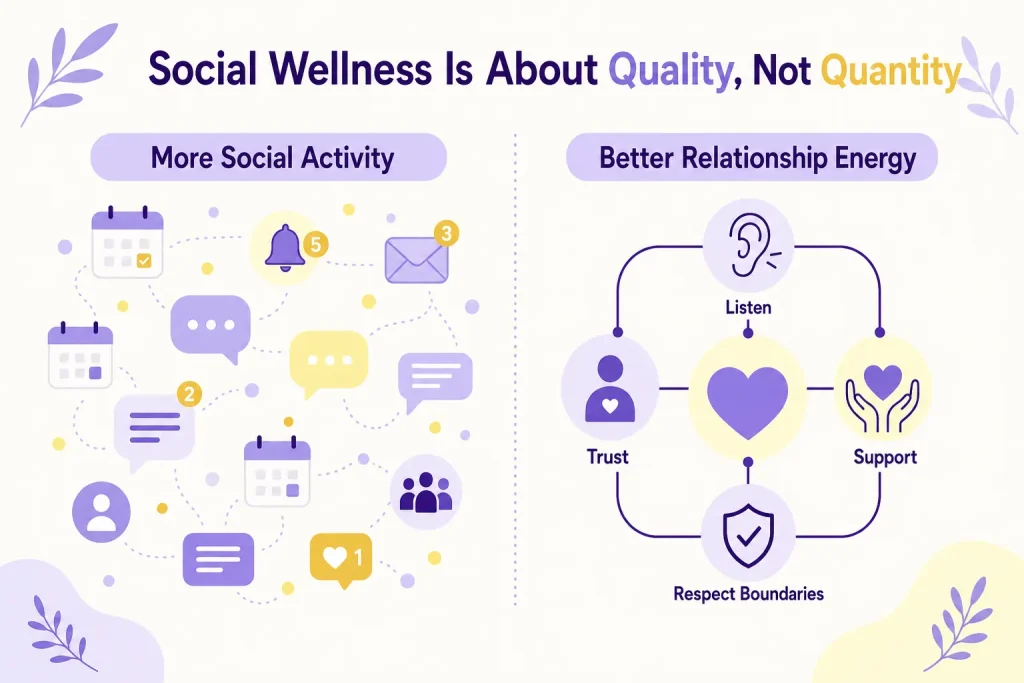
Is social wellness about more friends or better relationship energy?
Social wellness is more about better relationship energy than having more friends1,7. Strong social wellness can come from a few supportive connections that feel mutual, respectful, and sustainable1,3,7. This means noticing which relationships replenish you, which ones drain you, and what boundaries help connection feel realistic.
Quality over quantity
Quality often matters more than quantity because social wellness depends on how supported, respected, and connected a relationship feels7. A smaller circle can still support well-being when those relationships include trust, emotional support, and steady communication.
This is where many people get stuck.
They think better social wellness means a bigger social life. More plans. More texts. More events. More people to keep up with.
But more does not always mean better.
A large social circle can still feel lonely if the relationships are shallow, one-sided, or stressful2,7. A smaller support system can feel nourishing when the relationships are meaningful and reliable.
Better relationship quality can include:
- Feeling heard
- Feeling emotionally safe
- Having people you can count on
- Giving and receiving support
- Respecting each other’s limits
What “relationship energy” means
Relationship energy is the time, attention, and emotional bandwidth you have for connection. It helps explain why social wellness is not only about saying yes. It is also about knowing what kind of connection fits your real life.
Some seasons are full.
Work may be demanding. Family members may need more support. Your schedule may feel packed. Your social life might feel less like restoration and more like another task.
Relationship energy helps you ask a better question:
What kind of connection can I actually sustain?
That question is more useful than “Why am I not more social?”
What drains relationship energy?
Many people notice that connection can feel draining when it becomes one-sided, guilt-driven, or constantly available. Noticing these patterns can help you protect bandwidth and choose connection habits that feel more sustainable.
Draining patterns may include:
- Always being the person who reaches out
- Feeling pressured to respond right away
- Saying yes when you feel stretched
- Spending time with people who dismiss your feelings
- Relying on passive scrolling instead of real connection
- Keeping up with too many low-depth relationships
This does not mean every hard relationship is bad. It means your social wellness can benefit from honest reflection.
Some connections may need clearer boundaries. Some may need a different rhythm. Some may be better with less frequent contact.
What restores relationship energy?
Relationship energy can feel restored when connection is mutual, honest, and realistic1,3,12. Supportive relationships often leave room for active listening, shared routines, clear expectations, and space to be human.
Restorative connection can look like:
- A short walk with a friend
- A voice note that feels personal
- A family check-in without distractions
- A low-pressure community event
- A clear boundary that protects your time
- A conversation where both people feel heard
This is the heart of social wellness.
Not more noise. More meaningful support.
How does social wellness support mental, emotional, and physical well-being?

Social wellness can support well-being by helping people feel less alone, more connected, and more supported during stressful seasons. Research has linked social connection with mental, emotional, and physical health, but it should be framed as one part of a healthy lifestyle, not a guaranteed outcome1,6.
Mental and emotional support
Social wellness can support mental and emotional well-being by giving people places to feel seen, heard, and understood1,6,13. Meaningful relationships can offer emotional support during life’s challenges, especially when stress feels heavy.
Support can be quiet.
It might be someone listening without fixing everything. It might be a friend who remembers an important day. It might be a loved one who helps you feel less alone when things feel uncertain.
Positive relationships can also support self-esteem1,13. Feeling valued by others can help reinforce a stronger sense of belonging1.
Stress and life’s challenges
Supportive relationships may help people manage stress by creating space to share feelings, solve small problems, and feel less isolated1,6. Social support does not remove every challenge, but it can make hard moments feel less lonely.
A support system can help during:
- Big life transitions
- Busy work seasons
- Family stress
- Grief or disappointment
- Parenting or caregiving pressure
- Moments when motivation feels low
The support does not have to be dramatic. A steady check-in can matter. A shared walk can matter. A simple “I’m here” can matter.
Physical health associations
Social connection has been linked in research with physical health, while social isolation and loneliness have been associated with higher health risks1,2,5,6. These links should be understood carefully. Social wellness is one part of overall health, not a promise of specific results.
Public health discussions often connect social isolation with concerns such as heart disease, blood pressure, and mortality risk2,5. That does not mean one relationship habit controls health. It means social connectedness can be part of the broader picture.
A balanced view matters here.
Food, movement, sleep, routines, stress, environment, and relationships all interact. Social wellness belongs in that conversation because people often live healthier routines with support around them.
Healthy lifestyle patterns
Social wellness can support healthy lifestyle patterns when connection makes routines feel more consistent and less lonely1,3,4. A friend, family member, group, or community can add encouragement and structure to everyday habits.
Examples include:
- Walking with a friend
- Joining a local sports team
- Sharing a meal with loved ones
- Attending community events
- Checking in with someone during a stressful week
- Joining a volunteer group or interest-based class
These are small steps.
They can make a healthy lifestyle feel less like something you carry alone.
What are the benefits of social wellbeing?
The benefits of social wellbeing may include a stronger sense of belonging, more emotional support, better stress support, healthier relationship habits, and more meaningful daily connection1,3,6. These benefits often come from supportive relationships, not from trying to stay available to everyone all the time.
5 benefits of positive social connections
Positive social connections can support daily well-being by helping people feel more grounded, included, and supported1,6. The strongest benefits often come from meaningful relationships where communication, trust, and care are present.
Five possible benefits include:
- A stronger sense of belonging
Feeling connected to others can help life feel less disconnected. - More emotional support
Supportive relationships can offer comfort during challenging times. - Better stress support
Talking with someone you trust may help stress feel less isolating. - More chances for healthy routines
Shared movement, meals, hobbies, or check-ins can support consistency. - More meaningful connection
Strong social ties can help daily life feel more supported.
What social wellness is not
Social wellness is not popularity, constant availability, or saying yes to every invitation. It is also not measured by the number of people in your phone or the size of your online audience.
Social wellness is not:
- Being available all the time
- Having the most friends
- Attending every event
- Ignoring your own limits
- Staying in draining relationships out of guilt
Healthy relationships can include space. They can include boundaries. They can include quiet seasons.
A fulfilling life does not require constant social activity.
Why can social wellness feel harder for busy adults?

Social wellness can feel harder when life is full of work, caregiving, remote routines, and emotional overload8,10,11. Many adults are not avoiding connection because they do not care. They may be managing limited time, limited energy, and fewer natural chances for meaningful interaction.
Remote work can reduce casual connection
Remote work can reduce the small, casual interactions that once happened during commutes, breaks, or shared workspaces8,9. For some people, that means connection may require more intention than it used to.
A quick hallway chat disappears. A shared lunch disappears. Even small moments, like saying hello before a meeting, can become less common.
That can create more solitary time8,9.
Remote routines can still support social wellness, but they may need a different rhythm. A planned coffee chat, neighborhood walk, or co-working session might replace the casual contact that once happened naturally.
Caregiving can compress social time
Caregiving can compress social time because care responsibilities often take real energy, planning, and attention10,11. A person may want more connection and still feel too tired or time-limited to maintain it.
This can affect parents, adult children caring for relatives, partners, and people supporting loved ones through hard seasons.
The issue is not a lack of care for friendships.
Often, the challenge is bandwidth. Social life may get squeezed between work, home, errands, and recovery time.
Digital contact does not always feel nourishing
Digital contact can help maintain relationships, but it may not always feel nourishing4,6. Texts, likes, and scrolling can keep people loosely connected without giving the deeper emotional support they may be craving.
A balanced approach can help.
Digital tools can support social wellness when they create real connection3,4,6. A voice note, thoughtful message, shared photo, or scheduled call may feel more meaningful than passive scrolling.
The question is not whether digital connection is good or bad.
The question is whether it helps you feel supported.
Connection can start to feel like another task
Connection can start to feel like another task when your calendar is full and your emotional bandwidth is low. That does not mean you are failing at social wellness. It may mean your connection habits need to fit your season.
This is where relationship energy matters.
Instead of adding more plans, you can start smaller:
- One thoughtful message
- One short walk
- One honest check-in
- One boundary
- One shared routine
Small connection can still count. If that stretched-thin feeling is familiar, Brello’s guide to burnout recovery for women may offer helpful routine-first support.
Connection can also feel heavier when every small choice starts to pile up. That same mental load can show up as decision fatigue, especially when planning social time feels like one more decision.
What does healthy social wellness look like day to day?
Healthy social wellness can look like small, consistent moments of connection3,4. It may include checking in with a friend, practicing active listening, setting a boundary, joining a community event, or spending time with people who help you feel supported instead of drained.
Examples of social wellness
Social wellness can show up through everyday actions that build trust, support, and connection. It does not require a big event or a packed social calendar.
Examples include:
- Calling a friend
- Taking a walk with someone
- Practicing active listening
- Joining a volunteer group
- Going to a community event
- Setting a boundary with kindness
- Asking for help in a specific way
- Making time for meaningful relationships
The best examples are often realistic.
A short check-in that actually happens is more useful than a big plan that feels impossible.
Examples at home
Social wellness at home can look like simple routines that help family members or loved ones feel seen. These routines can create steady connection without requiring a major time commitment.
Examples at home include:
- Device-light meals
- A weekly family check-in
- Asking one thoughtful question
- Sharing a short walk
- Saying thank you out loud
- Giving someone your undivided attention
Small moments can shift the tone of a home.
They can also make support feel more visible.
Examples in your community
Social wellness in the community can come from low-pressure places where people gather around shared interests. Community connection can help expand support without making social life feel forced.
Examples include:
- Local sports teams
- Group physical activity
- Volunteer groups
- Book clubs
- Faith or cultural groups
- Classes or workshops
- Neighborhood events
A community touchpoint does not have to become a major commitment. It can simply be one way to feel less socially isolated.
How can you practice social wellness without feeling overwhelmed?
You can practice social wellness with small, low-pressure habits3,4. Consider one check-in, one meaningful conversation, one boundary, or one community touchpoint each week. The goal is not to fill your calendar. The goal is to build connection that feels supportive and realistic.
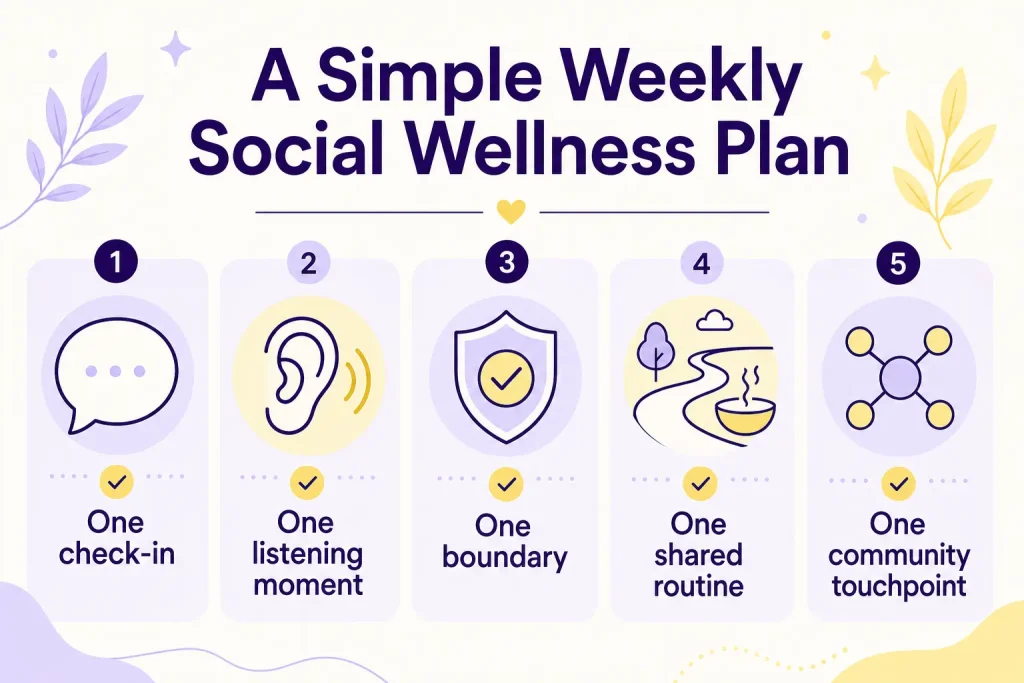
A simple weekly plan for social wellness
A simple weekly plan can make social wellness feel more manageable by turning connection into small, regular steps3,4. The plan should support your life, not add pressure to it.
Try a flexible rhythm like this:
- One check-in: Send a message to someone you care about.
- One active listening moment: Give someone your full attention.
- One boundary: Protect time, rest, or emotional space.
- One shared routine: Walk, cook, call, or sit together.
- One community touchpoint: Attend something low-pressure if it fits.
This is not a rule.
It is a menu. Choose what feels realistic. If building new routines has felt hard before, Brello’s guide on how to build healthy habits can help you think about small steps in a more realistic way.
What about the 5-3-1 rule?
One framework you may have seen is the 5-3-1 rule. It is often described as aiming for 5 different people or groups each week, 3 close relationships you nurture regularly, and about 1 hour of social interaction a day. It can be a helpful starting point for thinking about connection, but it is not a requirement.
If those numbers feel like pressure, the smaller, more flexible steps above work just as well. The rule is meant to be a prompt, not a test. Social wellness is less about hitting a target and more about connection that feels supportive and realistic.
5 ways to be socially healthy
Being socially healthy can start with small habits that support trust, connection, and emotional support. These habits can help maintain relationships without turning social wellness into another performance goal.
Five ways to support social health:
- Practice active listening
Put the phone down. Let the other person finish. Reflect back what you heard12. - Invest in a few meaningful relationships
Focus on supportive relationships that feel mutual and steady. - Set boundaries
Say what you can offer and what you cannot. - Create low-pressure connection routines
Try a monthly walk, weekly message, or shared hobby. - Join something that fits your energy
A class, local sports team, or volunteer group can support connection3,4.
If socializing feels like too much
If socializing feels like too much, start with a smaller form of connection. A short message, voice note, walk, or one-on-one plan may feel more realistic than a large event.
You do not have to force a full calendar.
Try one of these:
- Send a “thinking of you” text
- Step outside with someone for 10 minutes
- Share a song, photo, or memory
- Ask one honest question
- Choose a quiet plan instead of a crowded one
Small steps can support steady progress.
How can a Relationship Energy Check-In support social wellness?
The Relationship Energy Check-In is a simple self-reflection — notice which connections feel supportive, which feel one-sided, and where a boundary might help. This simple reflection keeps social wellness focused on quality, sustainability, and emotional support instead of pressure to keep up with everyone.
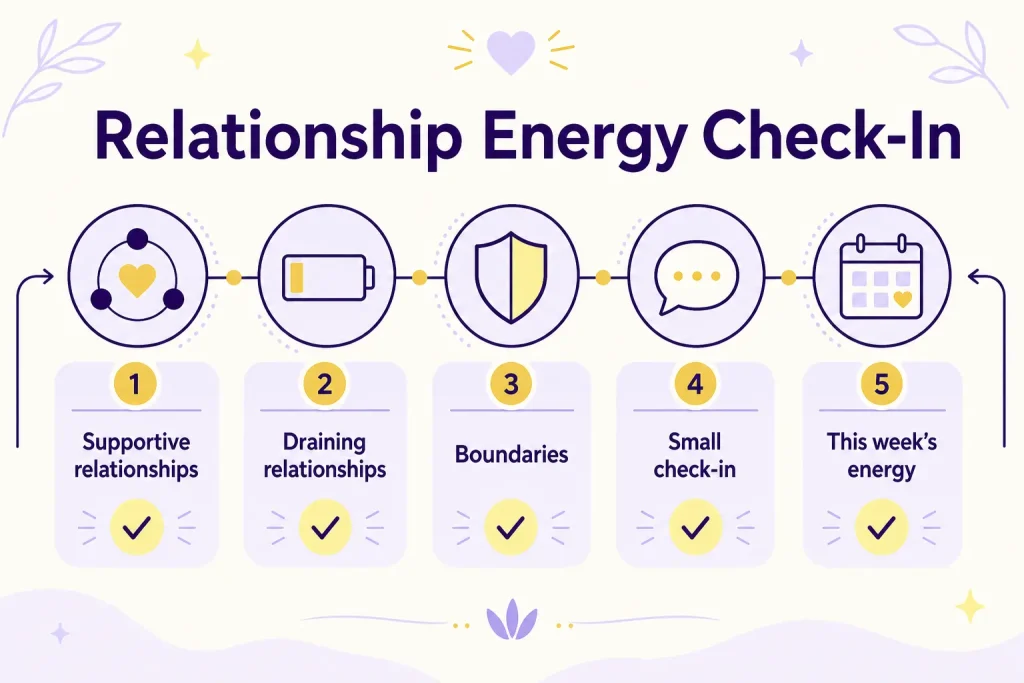
The 5-question Relationship Energy Check-In
A Relationship Energy Check-In works best when it stays simple, honest, and low-pressure. The goal is not to judge your relationships. The goal is to notice what supports your well-being and what may need a different rhythm3.
Ask yourself:
- Which relationships feel supportive right now?
- Which relationships feel draining or one-sided?
- Where might a boundary help?
- Who might appreciate a small check-in?
- What kind of connection fits my energy this week?
This turns social wellness into a practice.
Not a popularity contest.
How to use the check-in without overthinking it
The check-in can be used weekly or monthly as a simple reflection. It does not need a score, spreadsheet, or perfect plan. It can be one quiet moment to notice what your social life is asking for.
You might notice:
- A friendship you want to nurture
- A boundary you want to practice
- A group that feels supportive
- A pattern that leaves you tired
- A person you miss
Then choose one next step.
One is enough.
Common mistake: confusing availability with connection
Availability is not the same as connection12. Being reachable all the time can sometimes drain relationship energy instead of strengthening social wellness.
Connection is more about presence than constant response.
That might mean answering later with more care. It might mean saying no to one plan so you can show up better for another. It might mean choosing one meaningful conversation over five rushed exchanges.
Boundaries are not the opposite of support.
They can help make support sustainable.
What is the difference between loneliness and social isolation?
Loneliness is the feeling of being disconnected, while social isolation means having limited social contact or support2. They can overlap, but they are not the same. Someone can feel lonely around others, and someone with a small circle may still feel supported.
Why this distinction matters
This distinction matters because social wellness should not be judged by headcount alone. A person can know many people and still feel lonely2. A person can have a small circle and still feel emotionally supported.
Loneliness is about the felt experience.
Social isolation is more about the amount or reliability of social contact.
Both deserve compassion. Neither is a personal failure.
What to notice without judging yourself
Noticing your social wellness can start with curiosity instead of judgment. The goal is to understand what feels supportive, what feels missing, and what kind of connection might help your current season.
You might notice:
- You rarely have honest conversations
- You feel drained after certain interactions
- You do not know who to call when stressed
- You have people around you but still feel unseen
- You want connection but feel too tired to plan it
Start with noticing.
Then choose one small next step.
How can social wellness fit into a healthy lifestyle?

Social wellness can fit into a healthy lifestyle by supporting routines that help you feel connected, grounded, and encouraged1,3,4. It can pair naturally with movement, stress support, self-care, and community. Small shared habits can make connections feel more meaningful.
For a deeper real-life conversation around connection, wellness, and longevity, Brello’s Sandra Mason Project Longevity episode can offer another perspective.
Lifestyle pillar: routines and support
Social wellness can support lifestyle routines when connection makes healthy habits feel more shared and less lonely. A steady routine may feel easier to maintain when support is built into the week3,4.
This can look like:
- A regular phone call
- A shared meal
- A weekly walk
- A family check-in
- A recurring community activity
Support does not have to be big.
It just has to be real enough to count.
Mindset pillar: belonging and self-esteem
Social wellness can support mindset by helping people feel valued, included, and less alone1,13. Supportive connections may help reinforce self-esteem because they remind someone they matter beyond what they produce or manage13.
Belonging can be quiet.
It might feel like being remembered. Being listened to. Being invited. Being accepted without needing to perform.
These small moments can support steadier days.
Movement pillar: connection through shared activity
Movement can support social wellness when it creates a simple reason to connect3,4. A walk, class, local sports team, or community activity can help social connection feel more natural.
Shared activity can reduce pressure because the focus is not only on talking.
You can move, laugh, listen, and connect at the same time.
That can be especially helpful when sitting face-to-face feels like too much.
What are common mistakes people make with social wellness?
Common social wellness mistakes include trying to keep up with too many people, ignoring boundaries, relying only on passive digital contact, and treating connection like another task3,7,12. A healthier approach can start with fewer, more meaningful relationships and small habits that feel realistic.
Mistake 1: Measuring social wellness by friend count
Measuring social wellness by friend count can make connection feel like a numbers game. A large social circle does not always mean strong social support, and a smaller circle does not mean someone is socially unhealthy1,7.
Better questions include:
- Do I feel supported?
- Do I feel respected?
- Can I be honest?
- Is support mutual?
- Does this connection feel sustainable?
Quality gives a clearer picture.
Mistake 2: Saying yes when you are drained
Saying yes when you are drained can make social wellness feel harder to maintain. Setting limits can help you protect energy for the relationships that matter most.
A boundary might sound like:
- “I can’t make it tonight, but I’d like to plan another time.”
- “I can listen for a bit, but I don’t have much capacity today.”
- “I care about you, and I also need some rest.”
Clear does not have to mean cold.
Mistake 3: Waiting until you feel disconnected
Waiting until you feel deeply disconnected can make social wellness feel harder to rebuild. Small check-ins can help maintain relationships before they feel distant3,4.
A small check-in might be:
- “How have you really been?”
- “I saw this and thought of you.”
- “Want to walk this week?”
- “I miss you. No pressure, but I’d love to catch up.”
Small effort can keep a meaningful connection warm.
Mistake 4: Letting digital contact replace deeper support
Digital contact can help maintain relationships4. But passive digital habits may not always create deeper support6. A like or quick reaction can feel different from a real conversation.
Try using digital tools more intentionally.
Send the voice note. Schedule the call. Share the honest update. Use the tool to create connections, not just scroll around it.
What is a simple next step for better social wellness?
A simple next step is to choose one relationship and one small action this week3,4. You might send a thoughtful message, schedule a short walk, practice active listening, or set a gentle boundary. Small steps can make social wellness feel more manageable.
A 3-part social wellness reset
A social wellness reset can start with three small moves: notice, choose, and act3. This keeps the focus on steady progress instead of a complete social life overhaul.
Try this:
- Notice: Which relationships support you?
- Choose: What kind of connection fits your energy?
- Act: Take one small step this week.
That step can be quiet.
It can still matter.
Steady connection counts
Steady connection counts because social wellness is built through repeatable moments of support3,4. Not every connection needs to be deep, long, or perfectly planned.
A message counts.
A walk counts.
A boundary counts.
A real conversation counts.
The point is not to become more social overnight. The point is to build a social life that feels supportive, respectful, and possible. If you are trying to make check-ins feel more natural, Brello’s article on how long it takes to form a habit can help set realistic expectations.
Final Thoughts
Social wellness is really about feeling supported in the life you are already living, not building a bigger social calendar.
This week, choose one person who feels steady and send one honest check-in, voice note, or invitation for a short walk.
Connection does not have to be loud to matter. Sometimes the small, consistent moments are the ones that help life feel more grounded.
Frequently Asked Questions
What are 5 benefits to positive social connections?
Positive social connections may support belonging, emotional support, stress support, meaningful routines, and a stronger sense of community1,3,6. The benefit often comes from relationship quality, not from trying to maintain a large number of connections.
What are 5 ways to be socially healthy?
Five ways to support social health include practicing active listening, checking in with supportive people, setting healthy boundaries, joining a low-pressure group, and making time for meaningful connection3,4,12. These steps can stay small and flexible.
Can a small social circle still support social wellness?
Yes. A small social circle can still support social wellness when the relationships feel meaningful, respectful, and supportive1,7. Social wellness is not measured only by how many people you know. The quality of connection matters.
What is the 5-3-1 rule for socializing?
The 5-3-1 rule is a simple social-wellness guideline: aim for 5 different people or groups each week, 3 close relationships you nurture regularly, and about 1 hour of social interaction a day. It is often described as a helpful framework, not a requirement. If someone uses it, it can be treated as one optional way to plan connection. Social wellness can also be supported through smaller or more flexible routines.
What if socializing feels like too much?
If socializing feels like too much, consider a smaller form of connection. A short message, voice note, walk, or one-on-one plan may feel more realistic than a large event3,4. Social wellness can start with small steps.