The conversation
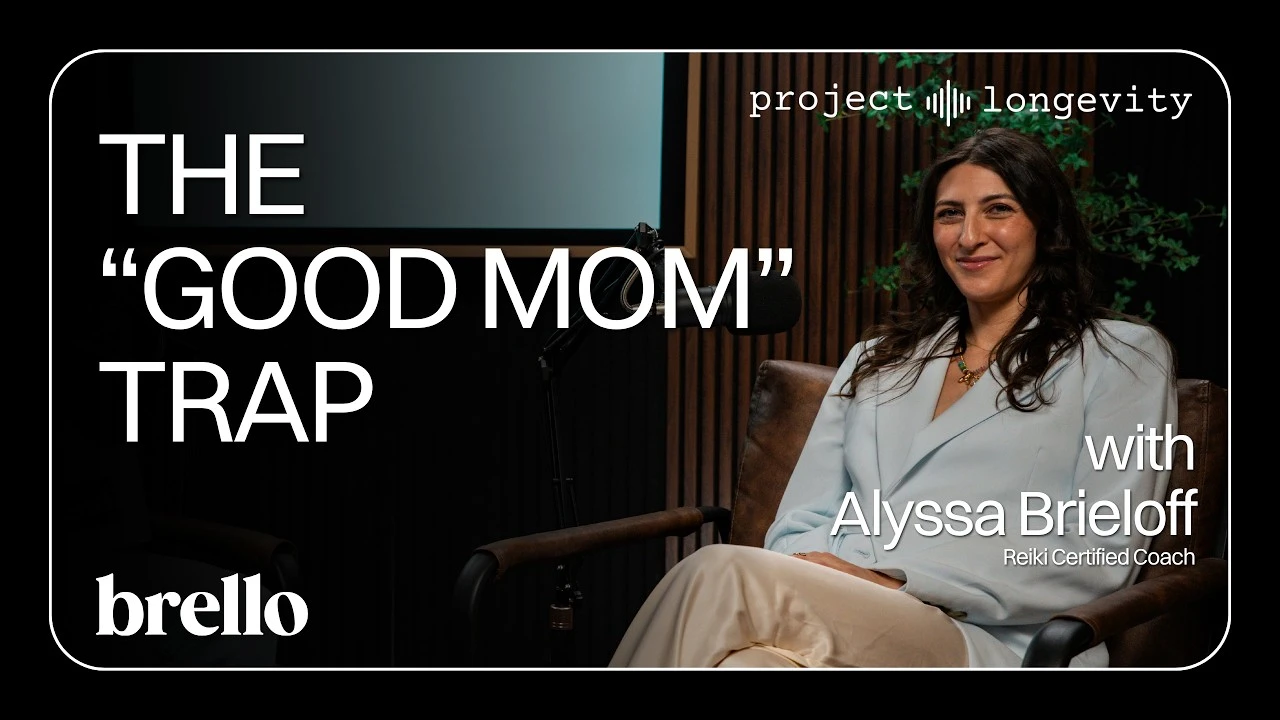
In this episode of Project Longevity — part of Brello Rise, Brello Health’s wellness content hub — host Caulen Foster sits down with Alyssa Brieloff, an expert in central nervous system regulation who blends that work with her experience of motherhood. Alyssa is the founder and host of the Magnetic Mama Club podcast, where she talks with other mothers about intuition, identity, and reconnecting with themselves after having children.
Her interest in energy work started unusually early. At eight years old, her grandmother brought her to a Reiki session — an experience she didn’t fully understand until much later, but one that planted an early belief that people are more than just their physical bodies. That belief followed her through a stressful stretch of college and a demanding early career in New York City, where she began building the tools she’d eventually lean on as a mother.
What makes the conversation land is that Alyssa doesn’t present nervous system work as a wellness add-on. She frames it as the thing underneath everything else — sleep struggles, chronic unexplained symptoms, mom guilt, and the identity upheaval of early motherhood all trace back, in her telling, to how regulated or dysregulated the nervous system is in a given moment. Caulen, whose own kids are grown, draws out both the theory and the day-to-day mechanics of how that plays out with a toddler in the room.
Prefer listening instead? Tune in to Project Longevity: Season 2, Episode 4 with Alyssa Brieloff on Spotify, Apple Podcasts, Amazon Music, and other major podcast platforms.




Her nervous system education started before she had words for it
Alyssa’s path into this work didn’t begin with a wellness certification or a health scare. It began with her grandmother taking her to an energy-healing session at eight years old — an unusual choice for a child that age, and one Alyssa still doesn’t fully understand the reasoning behind.
What she does know is that the experience shaped how she related to her own body and emotions from a young age. She grew up understanding, in her words, that people carry an energetic dimension alongside the physical one — a framework that’s become more mainstream in conversations about mindfulness and conscious parenting, but wasn’t widely discussed when she first encountered it.
That early exposure became a throughline. She carried the tools she picked up as a child into college and into her twenties, using them to ground herself during high-pressure stretches of life — first in school, then in the overstimulating pace of New York City after graduation.
By the time she became a mother, she already had a toolkit. What she didn’t have was a sense of how differently that toolkit would need to work.
New motherhood didn’t come with an instruction manual — so she stopped looking for one
Alyssa’s pre-motherhood practice was structured: two-hour meditations, aligned chakras, plenty of unstructured time. Becoming a parent collapsed that structure almost immediately, and she found herself, like many new mothers, turning to social media and mom groups for answers about sleep, feeding, and nearly everything else.
The problem, she says, is that so much of that advice gets presented as binary — sleep train or don’t, breastfeed or bottle-feed — when her actual experience lived in the gray area between. Consuming content that didn’t match her instincts started to erode her confidence in herself as a mother.
The shift came when she stopped consuming content that didn’t feel aligned with her own truth and started trusting her intuition instead. That didn’t mean abandoning outside input entirely — it meant being more selective about what she let shape her sense of what a “good mom” looked like.
It’s a small pivot with a large effect: less time spent measuring herself against a curated standard, more time spent noticing what actually worked for her and her daughter.
“Mirroring” means her daughter often reflects the parts of her she hasn’t yet accepted
Much of Alyssa’s content focuses on the idea of mirroring — the way children reflect back parts of their parents, including the parts parents haven’t fully faced in themselves. She’s careful to note that this isn’t just about her daughter reflecting who she is now. It’s about her daughter expressing emotions or behaviors that Alyssa hasn’t fully accepted or expressed in herself.
That reframe changes how she responds to hard moments. Instead of viewing her daughter’s big emotions as something to manage or correct, she treats them as information about her own unresolved patterns.
One of her strongest lines on this is her description of what happens when she doesn’t do that work: “She’s mirroring parts of me that I maybe haven’t fully accepted or expressed in myself, and that she is expressing.” It reframes a toddler’s meltdown as data, not just a behavior problem — a shift that asks more of the parent than of the child.
It’s a demanding lens to hold consistently, and Alyssa is upfront that she doesn’t always manage it. But it’s shaped how she interprets conflict with her daughter as an invitation rather than a failure.
Chronic, unexplained symptoms sent her back to her nervous system, not another specialist

Before she became known for nervous system work, Alyssa spent years cycling through doctors trying to explain a collection of symptoms — stomach pain, headaches, and other issues — that didn’t add up to a clear diagnosis. She attributes the underlying pattern to unresolved trauma tied to her parents’ divorce, which she says left her with abandonment wounds and a Type A, overachieving coping style.
She describes trying to “achieve” her way to better health — specialists, elimination diets, doing everything by the book — with only partial results. It wasn’t until she started addressing her nervous system directly that she noticed meaningful changes in both her physical health and her emotional capacity.
This is a place where the episode is careful to stay descriptive rather than prescriptive: Alyssa is sharing her own experience, not offering a diagnosis or treatment plan for chronic symptoms. Persistent, unexplained physical symptoms are worth discussing with a healthcare provider, and nervous system regulation practices are best understood as a complement to medical care, not a substitute for it.
Research does support a connection between chronic stress and physical health outcomes, which is one reason clinicians increasingly consider stress and nervous system state alongside other factors in unexplained symptom presentations — including patterns some readers recognize as adrenal fatigue symptoms.2
Nervous system regulation isn’t about staying calm all the time
One of the more useful reframes in the episode is Alyssa’s pushback on a common misconception: that being “regulated” means never getting triggered and staying calm at all times. She argues the opposite — that oscillating between activated and calm states is normal, and the goal isn’t to eliminate stress responses but to avoid getting stuck in them.
She explains this using three common nervous system states: fight-or-flight (an activated, on-alert state), freeze or shutdown (including a “functional freeze,” where someone appears to be functioning but feels disconnected), and a regulated, grounded baseline. Everyone moves between these states, sometimes multiple times a day.
This framework loosely echoes ideas that show up throughout trauma and nervous-system research, which describes the body moving between states of safety, mobilization, and shutdown in response to perceived threat. Alyssa isn’t presenting a clinical model, but her descriptions track with concepts common in that literature.
The practical implication, in her view, is that the win isn’t never getting dysregulated. It’s noticing when you are and having a way back.
Understanding your baseline state comes before any tool or practice
Asked where someone should actually start, Alyssa doesn’t point first to a specific app or technique. She points to awareness — understanding your own nervous system’s baseline before choosing a tool. Someone in chronic fight-or-flight might be an overdoer or overachiever; someone in freeze might feel like they’re functioning while running on autopilot.
Once someone has a rough sense of their pattern, she points to a mix of resources: the program To Be Magnetic, free content on YouTube, the meditation app Calm, and an app called Open, which she specifically calls out for its nervous system regulation library and dedicated motherhood section.
She’s also drawn to modalities that work through the body rather than through thinking alone — including EMDR (eye movement desensitization and reprocessing) and other forms of bilateral stimulation. EMDR is a structured therapeutic approach most established in the treatment of trauma-related conditions and is typically delivered by a trained clinician.3 More broadly, some body-based approaches, including diaphragmatic breathing, have preliminary evidence supporting their use for stress reduction.4 Alyssa’s use of related self-guided practices is personal, not clinical, and she frames them as one option among several — the same way some readers explore acupuncture for anxiety as another route into calming an overactive nervous system — rather than a universal recommendation.
Her broader point is that most people are operating from a subconscious layer of beliefs and triggers they aren’t consciously aware of — and that body-based practices, done consistently, are one way to work with that layer over time.
Motherhood taught her the difference between rupture and repair
Alyssa didn’t fully register how dysregulated she could get until her daughter reached the toddler stage. Moments of overstimulation — too much noise, too much need at once — could trigger something closer to rage than she expected from herself, despite years of nervous system work.

Rather than treating those moments as failures, she’s leaned into a rupture-and-repair model: she’s not going to get it right every time, but she can come back afterward, own the moment, and repair the relationship without putting that emotional labor on her daughter. In her words, she tells her daughter, “I had a bad moment. I’m really sorry” — without asking her daughter to manage or fix her feelings.
That distinction matters. Modeling accountability after a hard moment is different from expecting a young child to regulate an adult’s emotions, and it’s a theme that comes up throughout attachment-focused parenting research: consistent repair after rupture, more than the absence of rupture, is associated with secure attachment over time.5
For Alyssa, this has become less about achieving constant calm and more about building a reliable pattern of coming back.
Mom guilt rarely disappears — it just gets easier to recognize
Asked directly about mom guilt, Alyssa doesn’t offer a tidy resolution. She says she still feels it — even mid-conversation, thinking about being away from her daughter to record the episode.
What’s shifted is her understanding of where the guilt comes from. She points to Reconnected Parenting, a nervous-system-focused parenting resource she revisits periodically, which frames guilt as often rooted in a parent’s own upbringing: a mother who worked a lot might feel guilty working now, having decided (consciously or not) to do the opposite of her own mother.
Her core reframe is this: leaning into guilt keeps a parent stuck in the past or future rather than present with their child, which works against both of them. She sums up the shift plainly: “I’m actually a better mom because I take care of myself” — moving from “I have to be” toward “I get to be.”
It’s not a claim that guilt disappears with the right mindset. It’s a suggestion that naming where it comes from — the same first step behind most strategies to stop negative self-talk — makes it a little easier to not let it drive the day.
Matrescence reframes the postpartum identity shift as a rewiring, not a loss
The concept Alyssa returns to most is matrescence — the term for the psychological, hormonal, and identity transformation that comes with becoming a mother, often compared to adolescence. Unlike adolescence, she points out, mothers typically don’t have the same built-in support system of being cared for while they change.
This isn’t just a metaphor. Research using brain imaging has found measurable changes in gray matter structure in regions associated with social cognition during and after pregnancy — changes that persisted for years in some of the areas studied.1 Matrescence, as a term, is still working its way into more formal use, but the underlying idea — that becoming a mother involves real neurological and psychological change, not just a shift in schedule — has a growing evidence base.
For Alyssa, reframing the postpartum period this way was clarifying. Instead of trying to get back to who she was before, she could understand herself as someone who had genuinely changed — with less need to people-please, clearer boundaries, and a self-description she now calls “Type C”: still some Type A tendencies, but far more comfortable with imperfection.
Support looks different for every mother, and that’s the point
When Caulen asks how to balance motherhood with a career or a personal wellness journey, Alyssa resists a one-size-fits-all answer. Her first point is that the answer changes by season — the newborn stage is often closer to survival mode than a wellness routine, which is why burnout recovery often looks different for a new mother than it does at any other stage of life.
What she does insist on is the value of support, however that looks for a given family. For some, that’s a nanny. For others, it’s leaning harder on a partner, or family and friends providing meals. Alyssa describes leaning on her husband more than she was used to and building a version of a support “village” through social media, since she didn’t have extended family nearby.

The common thread isn’t a specific arrangement — it’s the willingness to actually accept help rather than defaulting to doing everything alone, which she connects back to the broader theme of the episode: regulation is harder to sustain in isolation.
Her comeback story was accepting a brain — and identity — that had permanently changed
Every Project Longevity guest is asked about their comeback story, and Alyssa’s centers on the same idea she keeps returning to throughout the episode: matrescence. Specifically, the moment she stopped trying to get back to her pre-motherhood self and instead accepted that her brain — and her priorities — had genuinely changed.
That wasn’t an easy shift. She describes feeling like part of her identity had died when her ambition temporarily receded, and she’d previously told herself she’d never become “a mommy blogger” making content about motherhood. That’s largely what her platform has become — but she frames it now as a calling rather than a compromise, driven by a sense that other mothers need the same permission she eventually gave herself.
The biggest piece she says she had to let go of was the “good mom” belief — the idea that doing everything right or perfectly was the goal — in favor of letting her daughter lead and trusting herself along the way.
The Bigger Picture
What runs underneath this entire conversation isn’t a specific technique or app — it’s a repeated insistence that regulation is a practice, not a permanent state. Alyssa doesn’t claim to have solved dysregulation, mom guilt, or the identity upheaval of new motherhood. She describes staying in relationship with all three, season after season, and getting a little quicker at recognizing when she’s stuck and finding her way back.
That framing has a practical use beyond parenting. Anyone managing chronic stress or a major life transition is likely oscillating between states of activation and calm in a similar way — and the goal isn’t eliminating the activation. It’s noticing it sooner and having a reliable way back to baseline.
Her closing point about matrescence is worth sitting with even outside the context of new motherhood: identity change that comes from a major life transition doesn’t have to be treated as loss. With the right framework, it can be treated as a rewiring — one that, in her case, made room for firmer boundaries and a more honest version of herself.
Enjoyed this conversation? Revisit our episode with Megan Sheley on cooking through an autoimmune diagnosis, where a different kind of hard-won, ordinary-and-repeatable practice does the same quiet work.