The content provided is for informational purposes only and should not be construed as medical advice; it is not a substitute for professional medical consultation, diagnosis, or treatment.
The conversation
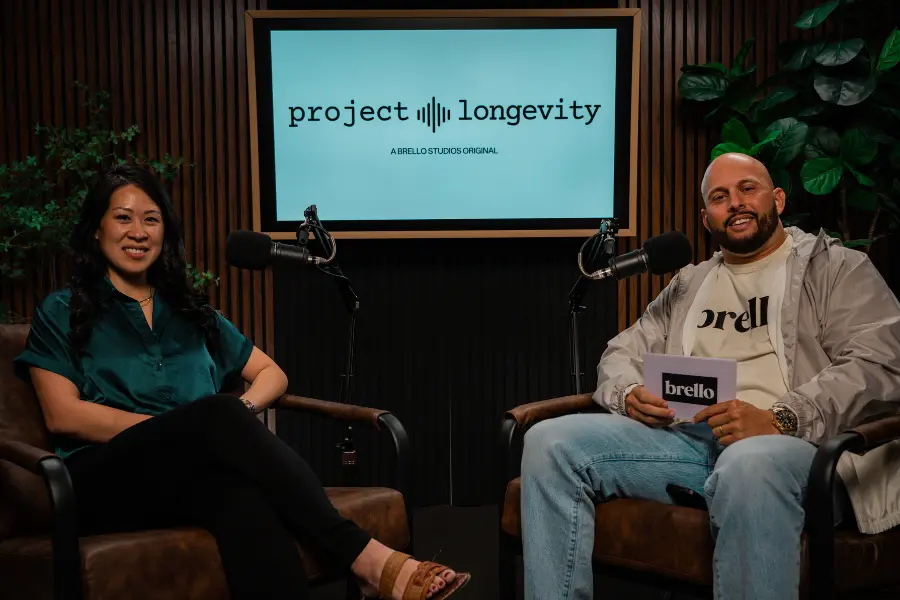
In the Season 2 premiere of Project Longevity, host Caulen Foster sits down with Dr. Stephanie Chan, Brello Health’s Director of Education, a functional nutritionist, fertility expert, pharmacist, and mother of two. Stephanie has focused on a deceptively simple idea: that women’s hormones respond, powerfully, to the foundations of daily life — what they eat, what they put on their skin, how they sleep, and how safe their bodies feel.
What makes her perspective land is that it’s lived as much as studied. She trained as a pharmacist and watched young women handed a single prescription for every hormonal complaint, then navigated her own long road to conception — learning firsthand that the “healthy” habits she’d absorbed in her teens were quietly depleting her. Across the episode, she and Caulen move from the pill’s outsized role in women’s medicine, through the hidden hormone disruptors in our homes, and into fertility, postpartum recovery, and perimenopause. The throughline is empowering rather than alarming: small, controllable changes, layered consistently, tend to move the needle more than any quick fix.
Prefer listening instead? Tune in to Project Longevity: Season 2, Episode 1 with Dr. Stephanie Chan on Spotify, Apple Podcasts, Amazon Music, and other major podcast platforms.



Listen to the full episode of Project Longevity on Spotify, Apple Podcasts, or Amazon Music.
Her story starts in a teenage doctor’s office

Stephanie traces her path back to her own adolescence. Puberty is one of two major windows — the other being perimenopause — when a woman’s hormones shift dramatically, and for her that showed up as an irregular cycle beginning young. By the time she was 16 or 17 and still seeing doctors about it, she says the only solution ever offered was the birth control pill — a pattern she’d later recognize everywhere, including in her own pharmacy practice.
That early experience planted a question she’s still exploring. Many women her age, she notes, have now been on a synthetic hormone for a decade or more — long enough that their natural cycles were, in her words, essentially “taken over.” Watching clients struggle to conceive years later, she began connecting the dots back to that first prescription.
Birth control gave women freedom — then became the only tool in the toolbox
Stephanie is careful not to demonize the pill. She’s quick to acknowledge it as a genuine positive for women’s health: it allows family planning and can ease real symptoms. Her concern is narrower. Too often the pill is used as a treatment because it’s one of the only tools many practitioners have — women arrive with acne or painful periods, and the response is to shut down their hormones so the symptoms disappear, rather than to ask why they’re there. Combined hormonal contraception is, in fact, widely used to manage acne and menstrual complaints, which reflects how routine this has become.1
For Stephanie, that’s the disconnect. Suppressing a symptom isn’t the same as resolving its cause, and a generation of women is now discovering that difference in retrospect.
Coming off the pill, many women notice they feel, and think, differently
Some of the most striking moments come when Stephanie describes what women report after stopping the pill. They often say they think differently, and even that their feelings toward their partners shift — because, as she puts it, the effect is “more than just a hormonal impact.” Caulen picks up the thread, noting how much literature is now emerging on mood, mental clarity, and hormonal contraception — science, he says, finally catching up to what women have described for years. The research is still evolving, but large studies have found associations worth taking seriously: one Danish cohort of more than a million women linked hormonal contraceptive use to a modestly increased likelihood of a first depression diagnosis and antidepressant use, with the strongest signal among adolescents.3
Stephanie’s point isn’t to frighten anyone off the pill, but to validate women who’ve felt dismissed. Reassuringly, the evidence also shows fertility typically returns quickly after stopping: a meta-analysis of nearly 15,000 women found about 83% conceived within a year of discontinuing contraception.2
Hormone balance starts with what you can actually control
When Caulen asks how women can begin improving hormonal balance holistically, Stephanie doesn’t reach for a supplement. She points first to the environment. We are, she says, constantly surrounded by chemicals that can change or mimic our own hormones. She worries that this hormonal disruption may be one factor behind the growing attention to painful periods and hormone-related conditions like endometriosis and PCOS, which already affect a substantial number of women.6,7 These chemicals aren’t only ingested; many can be absorbed through the skin from everyday cosmetic products.4,5
Her second foundation is minerals, which she calls the bedrock of health because they’re involved in virtually every metabolic process in the body — a role well established in the science on essential minerals and enzyme function.8 Clean up your surroundings, nourish the foundation: that’s where she starts.
The candles you love might be quietly working against you
The candle conversation gets personal. Caulen admits that he and his wife have always loved candles — in the house, in his office — but don’t love them quite so much anymore, and he asks why they come up so often as a disruptor. The answer is fragrance. We gravitate toward those scents, Stephanie explains, but many synthetic fragrances contain chemicals that can act as endocrine disruptors, including compounds that may mimic or interfere with estrogen signaling.4,5 She worries that this kind of hormonal disruption may be one contributor to hormone-sensitive problems like fibroids, heavy periods, and painful cycles. Fragrance chemicals such as phthalates are common in scented products and are among the endocrine-disrupting compounds regulators actively study.4,5
She adds a subtler point: modern homes are increasingly sealed. We don’t open our windows the way we used to, so whatever we diffuse indoors lingers. The takeaway isn’t fear — it’s awareness of the things we never think twice about because they simply smell good.
Your laundry detergent and makeup deserve a second look
Pressed for other everyday culprits, Stephanie names laundry detergent first. Residue stays in the fabric after washing, sitting against skin all day — and skin, she emphasizes, can absorb some of these chemicals over time.5 She jokes that her husband gives her grief over the fragrance-free detergents she buys, but with two young kids at home, limiting their exposure is a trade she’ll gladly make. Makeup is next: it’s why “clean” beauty labels exist, since pigments and chemicals sit on the skin, the body’s largest organ, and may be absorbed from there. Fragranced lotions fall into the same category as candles.
None of this requires a hazmat approach. It’s about noticing the low-hanging fruit — the products in constant contact with the body, where a simple swap can meaningfully lower the load.
Progress beats perfection when you’re cleaning up your environment

Caulen and Stephanie land on a reassuring philosophy. He mentions using essential oils like tea tree oil to clean, while admitting he still uses conventional products too — and Stephanie’s response captures her whole approach. “It’s not about being perfect,” she says. We can’t control the detergent a hotel uses or every exposure while traveling, so we start with what we can, and that begins at home. One better step, Caulen offers, is still better.
It’s a small exchange, but it sets the tone for everything that follows: sustainable change comes from consistent, imperfect progress, not an impossible standard.
Fertility struggles aren’t always about egg quality — sometimes they’re about safety
When the conversation turns to conceiving naturally, Stephanie challenges a common assumption. Many of the clients who come to her are already doing “the right things” — if anything, too much. They’re tired and don’t feel like working out, but they push through anyway because they’ve been told to intermittent-fast off the last five pounds and add fasted cardio on top. Her intervention is to dial it back to the foundations. She doesn’t fixate on the scale: if a client is eating 1,200–1,300 calories while doing hard workouts four times a week, she recognizes a body running on empty — a state well documented in reproductive medicine as a driver of missed periods and impaired fertility.9
Postpartum recovery isn’t six weeks; it can take a year or more
Stephanie extends the same principle into motherhood, drawing on her own experience. Too many women feel they must snap back the moment a doctor clears them to exercise, resuming exactly what they did before pregnancy. She counsels the opposite: support the foundations first if you actually want to bounce back. She echoes what the birth workers in her community tell clients — that postpartum isn’t just the first six weeks or even the “fourth trimester.” In her words, “it sometimes takes a year, a year-plus, to get back to your baseline, and sometimes you may never get there, and that’s okay.”
That last phrase is the heart of it. Caulen notes how often he sees members describe never feeling quite the same years after having children — not an identity crisis, but a physical reality. Stephanie’s message removes the blame: recovery is long, nonlinear, and deeply individual.
Perimenopause can last a decade, and your hormones are shifting the whole time
For women who feel “off” years after childbirth, Stephanie widens the lens to age. Women are having children later, often in their mid-30s, which can overlap with the years-long transition toward menopause — a process that typically begins in the 40s and unfolds gradually rather than as a single event.10 Exactly when perimenopause starts in women — and how long it tends to last — differs from one woman to the next. During this window, she explains, the hormonal shifts can feel like the body working against you. Women often become more insulin resistant and carry more weight around the midsection — changes she frames as protective mechanisms rather than personal failures, and which research on the menopausal transition documents as a real rise in visceral fat and shifting metabolism.10,15
Understanding progesterone’s role in sleep and calm
Caulen asks what women most often misread as “something wrong with me” when it’s actually biology. Stephanie’s answer is hormonal. As the ovaries wind down, estrogen naturally declines — and so does progesterone, the hormone the body makes after ovulation.10 That progesterone decline matters more than many realize. It’s tied not only to fertility but to sleep and a sense of calm; progesterone’s metabolite, allopregnanolone, acts on the brain’s calming GABA system.11 As progesterone declines, some women report feeling more easily agitated or finding it harder to wind down at night — experiences consistent with progesterone’s role in the brain’s calming pathways.11 The same estrogen–progesterone shift can also lengthen cycles.
The reframe is compassionate: these aren’t character flaws or failures of willpower. They’re predictable consequences of a shifting endocrine system — and understanding that is the first step toward addressing them.
Hormone-friendly eating starts in the gut
Asked which foods to limit for hormone balance, Stephanie names processed sugar and ultra-processed foods. Beyond offering fewer nutrients, they add a layer of inflammation the body has to manage — an effect increasingly supported by research linking ultra-processed diets to low-grade inflammation.13 But her more interesting point is where it all converges: the gut. Everything we eat affects the gut, which governs how well we absorb food and, crucially, how we clear the metabolized byproducts of our hormones. When gut health falters, she explains, estrogen can effectively be recycled back into the body, feeding the very estrogen–progesterone imbalance women are trying to resolve. This is the estrobolome at work, and the enzyme beta-glucuronidase is a well-studied player in how gut microbes regulate circulating estrogen.12
Too much caffeine, reliance on it to get through the day, and alcohol all tax that same system. For Stephanie, hormone health and gut health aren’t separate projects — they’re the same one.
The simplest gut-health upgrade is to slow down and chew
Rather than sending anyone to buy another probiotic, Stephanie keeps her gut advice almost startlingly simple: focus on digestion, and chew your food. So many of us eat while scrolling, constantly stimulated and stuck in a low-grade fight-or-flight mode, she says — and admits she’s guilty of it too. But digestion happens in the opposite state. To truly “rest and digest,” the body needs to be calm, a function of the parasympathetic nervous system that governs digestion and nutrient absorption.14 Put the phone down, make dinner conversational, and chew thoroughly.
The payoff is immediate and tangible. Chewing well helps break food down so nutrients are actually absorbed, and it reduces the large, poorly digested particles that can set the stage for bloating and gut overgrowth. Start there, she promises, and you’ll likely feel less bloated and less weighed down.
Health was never meant to be this complicated
Caulen reflects that everything Stephanie has offered is refreshingly lifestyle-centric — no complex formulary of supplements required. She agrees, and names the real obstacle: social media makes health look impossibly complicated, as if wellness demands collagen, vitamin D, and a cabinet of pills. Her counter-message is that the foundations, done consistently, let everything else fall into place. Sleep, eating, and what you put on your skin sound obvious, but they get drowned out by the noise of endless information.
That philosophy is rooted in her own comeback. Trying to conceive her first daughter, she was eating far too little, chasing a certain size in an era that demanded it, and left her body depleted. Reversing it took a long time and meant gaining weight that made her uncomfortable in her own skin. Yet, in her words, “this is actually what my body needed to feel safe for having a child.” The lesson she now passes to every client: release the pressure of what you think you should do, and lean into what feels right for your body.
The Bigger Picture
If there’s a single thread running through this conversation, it’s that hormone health is less about intervention and more about foundation. From the teenager handed a prescription for an irregular cycle, to the woman doing everything “right” and still struggling to conceive, to the perimenopausal woman blaming herself for changes her biology set in motion — Stephanie keeps returning to the same reframe: the body isn’t broken. It’s responding, logically, to its inputs and its stage of life.
That reframe is quietly radical because it hands agency back to women. You can’t control every exposure or stop time, but you can clean up your immediate environment, nourish the foundation, protect your sleep, and slow down enough to digest. None of it is glamorous, and none of it promises perfection — which is exactly why it’s sustainable. It also reflects how Stephanie sees expertise: as lived wisdom, not just credentials. She’s walked the depletion, the long road to conception, and the humbling nonlinearity of postpartum recovery. For anyone writing their own comeback story, her invitation is simple — start with the basics, be patient with your body, and let the rest follow.
Enjoyed this conversation? Revisit the Season 1 finale of Project Longevity to keep building your own foundation of longevity knowledge.