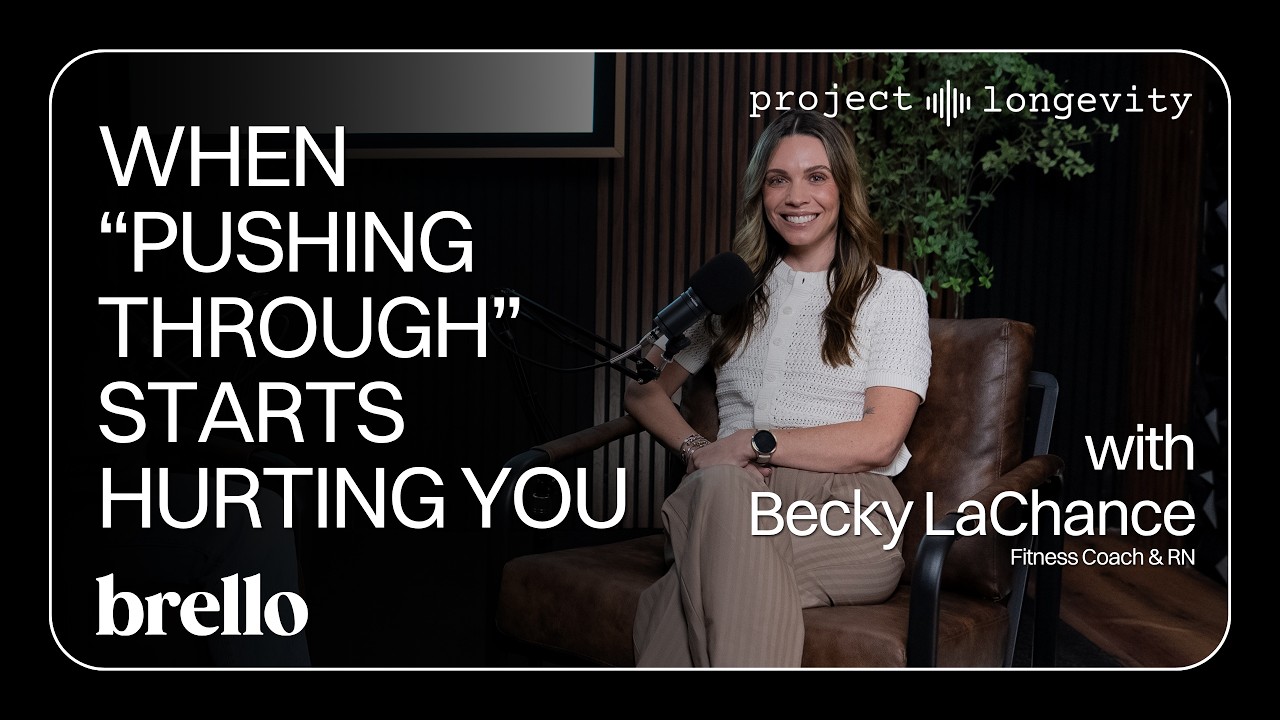
Becky LaChance knows burnout from both sides of the hospital bed. She’s a registered nurse with 14 years in the field, nine of them in the ICU, as well as a NASM-certified personal trainer and the founder of Move with Strength, a coaching program built specifically for health care workers. More than 107,000 people follow her for practical fitness and nutrition tips grounded in a simple idea: get 1% better every day.
In the sixth episode of Project Longevity’s Season 2, “Stress Management 101: How to Make Sure Being Busy Doesn’t Make You Unhealthy,” host Caulen Foster asks how she juggles full-time nursing, nurse practitioner school, a coaching business, and a wedding. Becky walks through the habits she relies on now and the low point that taught her to build them. The through-line may sound counterintuitive to anyone wired to push harder: sometimes the most productive thing you can do is slow down.
Prefer listening instead? Tune in to Project Longevity: Season 2, Episode 6 with Becky LaChance on Spotify, Apple Podcasts, Amazon Music, and other major podcast platforms.



A full plate is easier to carry when you’re excited about what’s on it
Becky admits she doesn’t fully know how she keeps up, beyond putting her head down and working. But she does point to one thing that makes it possible: nothing on her plate is draining her. She genuinely loves coaching, her job in patient placement, school, and the life she’s building with her fiancé. In her view, if she weren’t excited about those things, she probably couldn’t sustain them.
That’s an underrated part of stress management. Busy and depleted aren’t the same thing, and the difference often comes down to whether your obligations give anything back. Becky’s first lesson is to notice which parts of your life fill you up and which ones only take.
If it isn’t on the calendar, it probably isn’t going to happen
Becky talks a lot about balance on social media, so Caulen asks how she actually finds it. Her answer is refreshingly unglamorous: she schedules it.
Time with her fiancé goes on the calendar. So does time with a girlfriend. So does a nap. She treats these as appointments with herself or with people she cares about, because that’s the only way she’s found to make sure they happen.
When rest and connection live only in good intentions, they’re the first things to go in a crowded week. On the calendar, they get the same protection as a shift or a class.
A backup plan keeps one missed workout from becoming a missed week
Caulen asks what role structure plays in avoiding burnout, and Becky gets specific. Her process for clients starts with the non-negotiables: work shifts, kids’ activities, a spouse’s plans, doctor and dentist appointments. Those go on the calendar first. Workouts and meal prep get scheduled around them.
Then comes the step most people skip: a backup plan. If you need extra sleep and the morning gym session isn’t going to happen, it moves to the afternoon or the weekend. If the gym isn’t possible at all, the trade-off might be a walk.
Becky’s framing takes the guilt out of it. A missed workout isn’t a failure when you planned for the possibility. It’s just the backup plan doing its job.
Sleep is the foundation everything else is built on
If there’s one non-negotiable in Becky’s approach, it’s sleep. In her 20s, she sacrificed sleep for workouts all the time. Now she teaches the opposite. One of her strongest lines is simple: “Sleep is the foundation of everything.”
Her reasoning is a chain reaction Caulen says he’d never heard framed quite that way. When sleep is off, nutrition and workouts follow. You’re more prone to injury, and you reach for more food and more caffeine. That’s why she’d rather a client skip a workout and get an extra hour or hour and a half of sleep.
The research lines up with her experience. The CDC recommends at least seven hours of sleep a night for adults and notes that enough sleep may help reduce stress, improve mood, and sharpen attention and memory.3 In one small controlled study, just two nights of restricted sleep was associated with lower levels of leptin, a hormone that signals fullness, higher levels of ghrelin, a hormone that signals hunger, and increased appetite, especially for calorie-dense foods.4
Becky’s version is more practical than clinical: protect sleep first, and the rest of your habits have something to stand on.
Burnout rarely arrives all at once
Caulen asks what early burnout looks like, since some of it can be mistaken for regular tiredness. Becky’s list is familiar: feeling tired, more irritable, a little down, or noticing a change in your mood. You might eat more or eat less. Sleep starts getting pushed to the back burner.
Any of those can happen in a normal week. What matters, she explains, is duration: when the signs stretch for months or a year, that’s when it becomes a real problem.
The World Health Organization describes burnout as resulting from chronic workplace stress that hasn’t been successfully managed, marked by exhaustion, growing mental distance or cynicism toward one’s job, and reduced professional efficacy.2 And health workers are especially exposed. A CDC analysis found that the share of health workers who reported feeling burned out “very often” rose from 11.6% in 2018 to 19.0% in 2022.1
The takeaway is to watch the pattern, not just the bad day. If you want to go deeper on the signs and what may help, our guide to burnout recovery for women walks through it step by step.
Five minutes of fresh air can count as time for yourself
When it comes to managing stress, Becky starts with a caveat: what works for her might not work for you. The first step is figuring out what makes you feel calm and at ease. For her, it’s a 10-minute nap. Caulen laughs that she’s clearly a sleeper, and she agrees, with one exception: she can’t sleep on planes.
Her second tip is aimed at people who feel like they have no time at all, like nurses on 12-hour shifts or moms home with kids all day. Find a few minutes anyway. Step outside for five minutes of sunlight and fresh air between patients or on a quick lunch break. Take a few deep breaths in the bathroom. Grab a sip of water in the break room, then go back out. Small resets like these are one practical way to regulate your nervous system when a shift doesn’t leave room for much else.
The National Institute of Mental Health lists similar small steps for coping with stress, including relaxation exercises like deep breathing, a consistent sleep routine, and reaching out to people who help you cope in a positive way.7
When Caulen asks for her number two strategy after sleep, Becky lands right here: taking time for yourself, even in small pockets. Otherwise, you’re running from one task to the next, and that’s when burnout starts.
On a 12-hour shift day, the hospital is the workout
Becky didn’t always understand this one. As a new nurse, she thought staying fit meant working out six or seven days a week. For someone working long shifts, she now says, that just isn’t realistic.
Most hospital nurses work three 12-hour shifts a week, and there’s no getting to the gym on those days. So she teaches clients to move their workouts to their days off. That still leaves three or four days a week to train.
On shift days, you’ll be walking all over the hospital anyway, so Becky treats those as active rest days focused on good nutrition, water, and sleep. Instead of fighting a schedule that won’t cooperate, you build the plan around the one you actually have.
Three strength days and a lot of walking beat more cardio for a stressed body
Caulen asks if Becky has a preferred split for overall health. Right now, hers is at least three days of strength training a week, plus walking outside of that.
She doesn’t think people with stressful, busy lives need a ton of cardio. In her experience, constant HIIT and high-volume cardio can become one more stressor on the body. Walking, on the other hand, supports recovery, helps with stress, and makes it easier to hold on to the muscle you’re working to build. If walking isn’t part of your routine yet, a beginner walking workout plan can be a low-pressure place to start.
Her split fits comfortably within federal guidance, which recommends at least 150 minutes of moderate activity a week plus muscle-strengthening activity on two or more days.5 There’s also research behind her instinct about intensity. One study found that moderate- to high-intensity exercise raised circulating cortisol, a stress hormone, while low-intensity exercise did not.6
That doesn’t make hard workouts bad. It suggests that when life is already demanding, gentler movement may be the more sustainable choice.
Her lowest point came at the tail end of COVID
Caulen asks whether there was a moment when Becky realized she couldn’t keep going the way she was. There was, and it came near the end of the pandemic.
She was working 40 to 60 hours a week in the ICU, on both day and night shifts. Her patients were dying, and it was a deeply lonely time. She was in a bad relationship that, in her words, knocked her to the ground. She had also come off birth control after 16 years, and her body felt the strain from every direction at once.
On top of all that, she was still trying to work out five or six days a week. She gained about 20 pounds, her skin broke out, and she no longer felt like herself in her own body. Mentally, she describes it as the lowest place of her life. She had lost her dad about a year earlier, and then her dog was diagnosed with cancer.
Burnout is rarely about one thing. It’s usually several heavy things stacking up while you keep pushing through.
Slowing down felt uncomfortable before it felt right
Becky made two big changes. She stepped back from full-time nursing and went per diem for a while. And she cut her workouts from five to seven days a week down to three. Both made a huge difference.
Getting there wasn’t easy. Friends had been telling her to slow down, to swap some workouts for walks or yoga, and she didn’t want to listen. Eventually, her body made the decision for her. When Caulen asks how stepping back felt for a type-A high performer, she’s candid: she was antsy. Going from 100% to 50% or 60% was a shock, and it took time to feel okay with it.
The biggest piece of her rebuild was therapy. Alongside it, she kept three strength workouts a week, walked her dogs, and learned to be comfortable spending time alone, which she says was uncomfortable at first. Starting her coaching business helped, too.
Her advice for anyone in a low place starts with therapy and with letting yourself feel everything. It’s okay to cry, to be sad, to stay in bed, or to vent to people who are willing to listen. Psychotherapy is one of the most common forms of mental health care, and NIMH notes it can help people dealing with long-term stress, grief, or relationship problems.8
Healing took a year to a year and a half, not three months
Caulen asks how long it took to feel like herself again. Becky’s answer: a good year to a year and a half.
She admits she expected to feel like herself again in about three months. It didn’t work that way.
Caulen points out that people often assume coaches have it figured out all the time. Becky pushes back: there are seasons for everything. Some seasons you’re in the best shape of your life. In others, life knocks you down with a loss, a divorce, or a job change. Nobody has it together all the time.
That honesty matters. A longer timeline isn’t a sign that you’re doing recovery wrong. Sometimes it’s just what recovery takes.
One day at a time, and 1% better than last time

When a hard season drags on, Becky’s approach is the one her friends and her mom keep reminding her of: one day at a time. Instead of looking at the next week or the next three months, look at the day in front of you. What do you need to do to get through it? Then cross it off and move forward.
Her “1% better” philosophy grows from the same root. She uses holidays as an example. Many people approach big holiday meals with an all-or-nothing mindset and feel awful the next day. Her alternative is to do a little better than last time. Maybe two desserts instead of five. Maybe one mimosa instead of three.
She coaches clients the same way, meeting them where they are. Someone working out twice a week doesn’t jump to five; going from zero to 100, she says, leads to burnout, injury, and quitting after three weeks. Most clients start noticing changes around three months. That tracks with research suggesting new habits take an average of about 66 days to feel automatic, with a wide range from person to person.9 Our guide on how long it takes to form a habit explains why the 21-day rule falls short.
The wins aren’t always physical, either: lifting heavier, choosing one dessert instead of five, and a confidence that family and friends often notice first.
Chronic stress shows up in the body, and the fix starts with starting
Caulen asks what role stress management plays in body composition. In Becky’s experience, a big one. When everyday stressors turn into chronic stress, she sees clients feel more inflamed, hold on to more water, and eat more or less than usual. NIMH notes that stress and anxiety that don’t go away can affect sleep and the immune, digestive, and cardiovascular systems.7
So how do you start a new routine when your brain won’t slow down? Becky’s answer is almost disarmingly simple: just start. It will be hard at first. In her words, you have to “get comfortable with being uncomfortable.”
That’s also why she pushes clients to put themselves first, even for 10 or 15 minutes in the morning. Move your body, sit quietly with your coffee, do a little journaling, or sit down to a healthy meal. As she puts it, “If I don’t put myself first, I can’t show up for everybody else.”
The Bigger Picture
Becky’s story will sound familiar to anyone in a caregiving role: someone whose job is to show up for everyone else, running on empty until her body forced a pause. She doesn’t present her current routine as willpower. It’s a set of guardrails she built after learning what happens without them.
Almost everything she credits is ordinary: a calendar with naps on it, a backup plan for missed workouts, strength days and walks, five minutes of fresh air, therapy, and patience with a slow recovery. None of it is dramatic, and that’s the point.
Her “1% better” philosophy may be the most portable idea from the episode. It works for holiday meals, for a first week back at the gym, and for a season that feels like it will never end. You don’t have to fix everything at once. You just have to do a little better than you did last time, and then do it again tomorrow.
Enjoyed this conversation? Revisit our episode with Dr. Morgan Cutlip on mental load management, where the invisible work that keeps a household running turns out to be another quiet driver of the burnout Becky knows so well.