The conversation
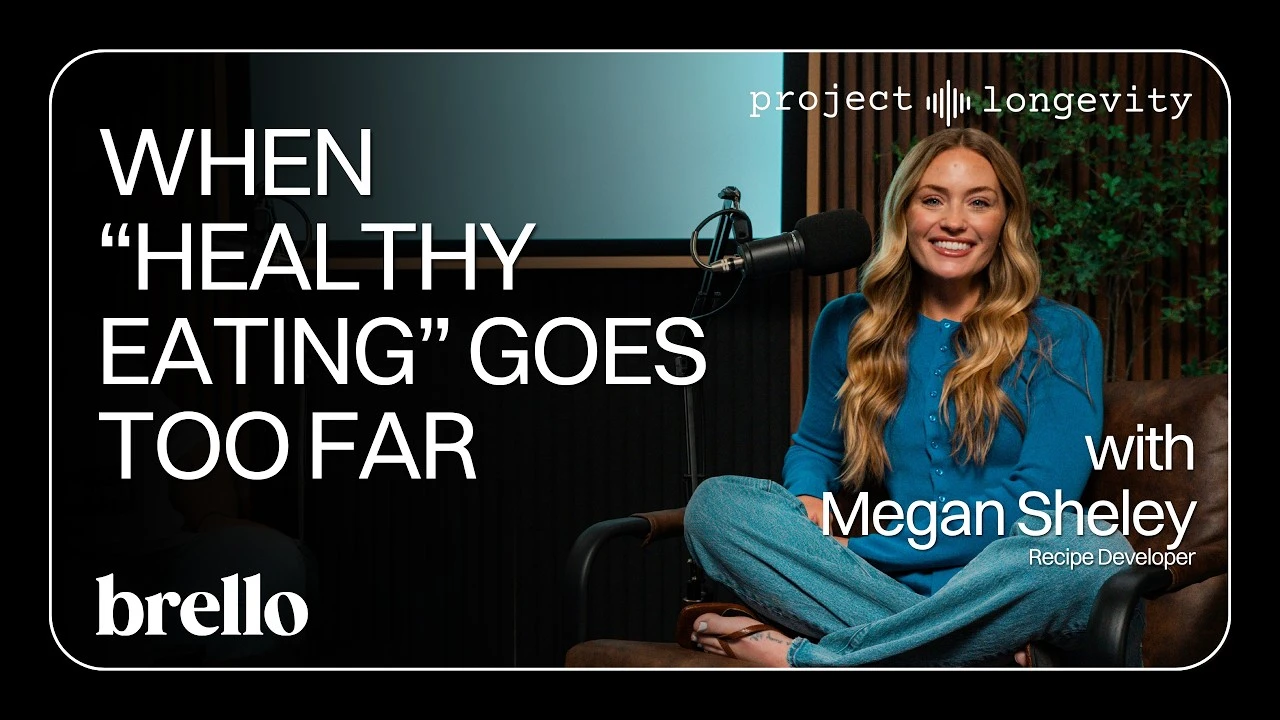
In the third episode of Project Longevity’s Season 2, host Caulen Foster sits down with Megan Sheley, a tell-it-like-it-is foodie turned recipe developer from Minneapolis. Megan studied public health, went into marketing, got laid off, moved to Thailand for a year, came back and returned to school for nutrition, and eventually built a career out of showing people that better-for-you food doesn’t have to taste like a punishment. You may recognize her from Season 4 of Next Level Chef.
What makes her perspective land is that it’s lived as much as studied. Partway through building a career on food, Megan was diagnosed with an autoimmune disease that made food both her livelihood and her most complicated variable. Across the episode, she and Caulen talk about what happens when the thing you build your life around is also the thing you have to manage carefully, and her answers stay unusually practical throughout: spice cabinets, 30-minute walks, and why breathwork works for her when meditation never has.
The through-line isn’t a diet or a protocol. It’s the idea that health gets built out of ordinary, repeatable things, and that holding your own standards a little more loosely is often what makes them sustainable.
Prefer listening instead? Tune in to Project Longevity: Season 2, Episode 3 with Megan Sheley on Spotify, Apple Podcasts, Amazon Music, and other major podcast platforms.



Listen to the full episode of Project Longevity on Spotify, Apple Podcasts, or Amazon Music.
Her obsession with food started long before it became a career

Megan’s first memory of caring about food isn’t a recipe. It’s a salad bar at overnight camp. While the other six-year-olds were writing home about kayaking and rock climbing, she was writing about the food.
That kind of early, unforced interest is worth noticing. She didn’t discover food as an adult project or as a fix for something. She was already paying attention.
She majored in public health in college, then went into marketing and did essentially nothing with the degree. The interest stayed parked for a few years.
A layoff and a year abroad pushed her to rebuild everything around food
Her job was acquired and the team was laid off. Megan moved to Thailand for a year, and somewhere in that year the marketing career stopped making sense to her. She wanted work that involved helping people, creating something, and using her hands.
She went back to school for nutrition and started working one-on-one as a nutrition coach, going into people’s homes, meal prepping, and clearing out pantries. It was useful work, but small in reach. When she started posting her better-for-you recipes online, those took off in a way the coaching never did.
That was the clarifying moment. The part she loved was being in her own kitchen and reaching a wider audience with what came out of it. Social media wasn’t a compromise on the work. It was the version of it that scaled.
Two beliefs keep most people out of the kitchen, and both are fixable
Caulen asks the obvious question: her recipes are accessible, so why don’t more people cook? Megan names two barriers, and neither is skill.
The first is time. People assume cooking is a bigger production than it is. The second is taste, and specifically the belief that healthy food is inherently bland. Somewhere along the way, “healthy” got collapsed into “kale, every day,” and her response to that is blunt. Nobody wants food that tastes like nothing.
She’s equally blunt about the environment people are cooking against. Eating well in the US takes real effort, and federal data backs her up: ultra-processed foods account for about 55% of calories consumed by Americans age 1 and older, and 53% among adults.1 The current Dietary Guidelines for Americans lead with an “eat real food” message built around whole, nutrient-dense foods.2
Her answer to both barriers is the same. Get into your own kitchen, where you control what goes in. Research has associated more frequent home cooking with lower daily intake of calories, fat, and sugar.3
A lasagna soup made during COVID changed her life in four days
Ask Megan for a favorite recipe and she’ll tell you it’s like picking a favorite kid, then immediately name the one she calls her life-changing lasagna soup, because it was.
She was home sick with COVID and wanted both lasagna and soup, so she combined them. Within four days the video had roughly 55 million views. Management teams started calling. It was the recipe that let her take content creation full-time, and it’s how Gordon Ramsay’s team found her for Next Level Chef.
People still stop her in airports to ask if she’s the lasagna soup girl. The detail worth holding onto isn’t the virality. It’s that the recipe came from experimenting while sick and bored, not from strategy.

She was sick for three and a half years before anyone had an answer
Megan was sick for about three and a half years before she got a diagnosis. When it finally came, she had questions her doctors couldn’t answer about the disease she’d just been told she had, which she found genuinely shocking.
She was prescribed a steroid and made her own decision not to take it, then went to a naturopathic doctor who ran bloodwork and found her inflammatory markers extremely elevated. She started an all-natural supplement regimen and describes being in remission within two weeks after years of being unwell.
It’s a striking story, and it’s worth being precise about what it is: her experience, not a protocol. Decisions about prescribed medication belong in a conversation with a licensed clinician who knows your history.
What her story does illustrate is how long and disorienting the road to an autoimmune diagnosis can be, and it’s a road women walk far more often than men. About 8% of the US population lives with an autoimmune disease, and nearly 80% of them are women.4
Chronic inflammation is the thread running through autoimmune conditions
When Caulen asks about her belief system around food and the body, Megan puts food in her top three levers for keeping an autoimmune condition in remission. Her reasoning is simple: autoimmune disease is chronic inflammation, and what you eat influences that.
The framing tracks with how researchers describe it. A major review in Nature Medicine positioned chronic inflammation as a common driver across a wide range of diseases, shaped over time by diet, stress, sleep, activity, and environment.5
Asked what she’d tell people to be mindful of, she names refined sugars in large amounts and alcohol, and, with a caveat that she personally tolerates dairy fine, the way a lot of dairy is produced in the US. She cut alcohol entirely for a year and a half after her diagnosis, which she credits with helping. Research published by the NIAAA describes how chronic alcohol use can disrupt the gut barrier and drive inflammatory immune activity.6
The takeaway isn’t a banned-foods list. It’s that she treats a handful of inputs as worth paying attention to, and lets the rest go.
Cooking at home became her way of controlling the variables
The reason Megan cooks as much as she does isn’t purity. It’s control. Cooking at home lets her decide what goes into her body on a given day, which matters more when a condition is directly affected by it.
After her diagnosis she cut alcohol, cut back sharply on refined sugars, and, at her worst, couldn’t digest raw vegetables at all. That’s a significant rewrite of how a person eats, and she had to do it while her public identity was built on food.
Her workaround was to make the constraint part of the work: inflammation-friendly recipes, and things that are easier on the gut during a flare. The kitchen stopped being the problem and became the tool.
Eating “perfectly” can become its own source of stress
This is the most quietly useful part of the conversation. Megan spent a stretch going 100% clean, reading every label and scrutinizing every ingredient, and it stressed her out. As she puts it, you have to have a little flexibility with it, or you’re going to drive yourself insane.
Caulen names the loop directly: the eating pattern meant to reduce inflammation becomes a source of stress, and stress is itself inflammatory. Megan’s response is immediate agreement.
She’s now firmly 80/20. She goes out to dinner. She wants the chocolate chip cookie. The rigidity, she found, builds its own kind of obsession, and being black-and-white about food is not the same thing as being healthy about it.
A better relationship with food is built through curiosity, not stricter rules
Megan points out that most women have struggled with their relationship with food at some point, and her approach to repairing that is less about rules than familiarity. Get in the kitchen. Handle the ingredients. Play with them.
That’s also what holds people back, she notes: the fear of not knowing what pairs with what. Her advice is unfussy. Play with it, try it, taste your food. Some of the best recipes come from exactly that, hers included.
Eating food that makes you feel good, she adds, is itself part of building a healthy relationship with it. Feeling good is information, not indulgence.

Herbs and spices are the most underused tools in the American kitchen
For anyone wanting one concrete upgrade, Megan’s answer is herbs. Fresh herbs transform a dish immediately. Cilantro or green onion over a red or yellow curry changes both the flavor and the way it looks. Caulen calls it contrast, and she agrees.
Spices are the other half. Coming from the Midwest, she has strong feelings about salt-and-pepper-only cooking. Her theory on why people think they hate chicken breast is that they’ve been boiling it and salting it. Season it, she says, because we have seasonings from all over the world available to us.
It’s a low-cost, high-return fix, and it directly answers the “healthy food tastes bad” objection she named earlier.
Turmeric is part of her routine, and the science is still developing
Megan cooks with turmeric constantly and takes a turmeric supplement daily as part of managing her condition, alongside EGCG, the active compound found in green tea. She describes noticing a difference within days.
The honest context matters here. NCCIH reports that research on turmeric and curcumin remains inconclusive for most uses, that products vary widely in potency and absorption, and that liver damage has been reported in some people using highly bioavailable formulations.7 For green tea, NCCIH similarly reports that definite conclusions can’t yet be drawn for most uses, and that liver injury has been reported primarily with concentrated extracts in tablet or capsule form.8
None of that invalidates her experience. It does mean supplements are a conversation to have with a clinician who knows your labs, your diagnosis, and anything else you’re taking, rather than something to copy from a podcast.
Stress may be the most underestimated inflammatory trigger for women
When Caulen raises the fact that autoimmune conditions overwhelmingly affect women and asks why, Megan answers in one word: stress. Her read is that women absorb more of it emotionally, and that the body holds what the mind carries.
Her naturopathic doctor told her the number one reason he sees patients pulled out of remission is major life stress, including grief, death, and divorce. Large-scale research points in a similar direction. A 2018 JAMA study of more than 100,000 people found that stress-related disorders were associated with a meaningfully higher risk of later autoimmune disease.9
Her own flare-up proves the point in a way she didn’t expect. It happened while she was competing on Next Level Chef, and it forced her to leave the competition early. She wasn’t stressed in the emotional sense, and was thrilled to be there, but her body had adrenaline and cortisol running for four weeks straight and responded as though she were in danger. As Caulen puts it, the body doesn’t always distinguish between real threat and sustained intensity.
Sleep, movement, environment, and breathwork are her stress toolkit

Asked what actually works, Megan lists four things, none of them exotic.
Sleep, which has never been a struggle for her, and which is deeply intertwined with immune function.10 Movement, daily, even if it’s just a 30-minute walk; federal guidelines recommend at least 150 minutes of moderate activity a week and note benefits for anxiety and sleep quality.11 Environment, which mattered enough that she moved to California for nature, water, and the ability to step outside at 8 a.m. and get sunlight.
And breathwork, which she uses to tell her nervous system it’s safe. She’s candid that meditation doesn’t work for her, because the pressure to “shut off” becomes its own stressor, and she’s only truly managed it a couple of times, usually after a long run. Caulen relates: he did a 45-minute sound bath and still isn’t sure whether he meditated or fell asleep.
Breathwork feels different to her because she’s in control of it, and you can still be thinking while doing it correctly. NCCIH notes preliminary evidence that diaphragmatic breathing may help reduce stress, and that heart rate variability biofeedback, which modifies breathing based on heart rate, appears helpful for self-reported stress and anxiety.12
Her comeback story was deciding to talk about it out loud
Every Project Longevity guest is asked about their comeback story, and Megan’s is the diagnosis itself, and specifically the fear that having a condition driven by food might mean giving up a career built on food.
What she did instead was talk about it publicly. Women flooded her messages. She started sharing inflammation-friendly recipes and things that helped her GI during a flare, and her condition became part of her content rather than something to hide from it.
She’s honest that acceptance took time and still comes in waves. Every flare-up reminds her this is lifelong. Her way through it is plain: this is the reality, and she’ll do what she needs to do to feel her best. Everyone’s battling something, she says, and this is just one of her battles.
Her purpose statement is the line that lands hardest. If she can make one person feel less alone in their autoimmune disease, that’s enough. Next up is a YouTube channel with long-form cook-along content, something closer to a live cookbook.
The Bigger Picture
What makes Megan’s story useful isn’t the diagnosis or the viral recipe. It’s that she arrived, through trial and error, at a version of health that’s sustainable, and that looked nothing like the version she started with.
The strict phase didn’t hold. The 80/20 version did. The supplements matter to her, but so do the 30-minute walks, the morning sunlight, the seasoning in the pan, and the ability to eat a cookie without spiraling. Almost everything she credits is ordinary and repeatable, which is precisely why it works.
There’s a broader point buried in her story too. Autoimmune conditions fall disproportionately on women,4 often after long stretches of not being believed or not being answered. Megan’s decision to talk about hers openly did more than build an audience. It gave a lot of people language for something they’d been managing quietly, and that’s its own kind of longevity work.
Enjoyed this conversation? Revisit our episode with Dani Marenburg on sustainable nutrition, where balance over restriction turns out to be the same lesson from a different direction.